Seeking Agential Patterns: Hyper-Agency, Rosicrucianism, Egregores, and the UAP-Question
Part 1.3: Disassembling UAP Mythology - Case Study #2: Our Lady of Fátima to the UFO of God

“To find the truth is rather simple… All you have to do is study the old story and bring it up to date.”
— Doreen Wilkinson, 1963*
“The same is true regarding accounts made by investigators of the higher Worlds. Each has his own peculiar way of looking at things and can describe only what he sees from his particular point of view. The account he gives may differ from those of others, yet all be equally truthful from each individual observer’s viewpoint. It is sometimes asked, Why investigate these Worlds?”
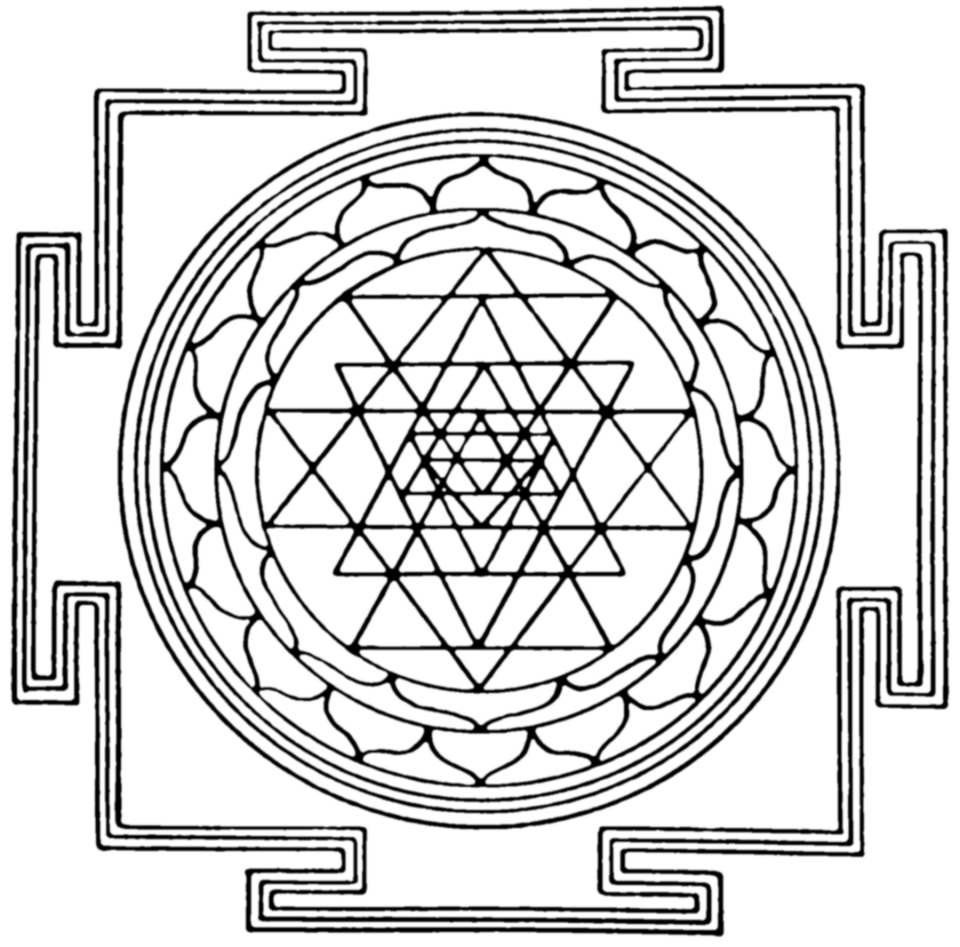
Sri Yantra: an ancient geometric structure used to strengthen and evoke ritual, prayer and meditation. (Source: N.Manytchkine — CC BY-SA 3.0)

Arriving at the thesis that the daunting topics of UAP, hierophanic encounters, egregores, and frontier biology all point towards a universe in which mind is not isolated inside the human skull, but distributed across scales, substrates, symbols, networks, and agencies. So, just to be clear:
Parts 1.1 and 1.2 of this series set up a philosophical framework for what hyper-agency means and why egregore is not just a metaphor in myth but an actual structural entity capable of intense causal influence. Next, Part 2 and 3 will review two related cases: Our Lady of Fátima and the UFO of God, which combine multiple unique but comparable conditions for assessing the connection between UAP, spiritual phenomenon and agential behaviours. Now, in this article, we will look closer at anthropocentric cases involving egregores, hyper-agency, UAP and mystery traditions. That leads us to consider that,
if hyper-agency is really expressed in other “higher-orders” of non-human intelligence (e.g. UAP, hierophanic entities), and if it can operate in the physical world through egregores, and if “mind” really is scale-invariant the way frontier biology suggests, then the UAP-question is not just a question about phenomena in the sky but a mark more indicative of our place within a diverse network of overlapping intelligences.
Told you it was daunting—albeit undeniably exciting, too.
Why UAP Undermine Game Theory
Let’s take a step back for a minute. Ironically, having previously introduced Evolutionary Game Theory (EGT) as an interpretive tool for the ever-elusive UAP-question, this comparative case study has since taken a rather abrupt turn. Autopoietically realigning itself towards the very antithesis of cold, objective measure, otherwise known as re-enchantment. Personally, I’m glad. Conflating true religious experiences to game theoretic agential strategy felt a little reductionist, bad taste no matter where on the spiritual spectrum you sit.1 Thankfully re-enchantment becomes the necessary ying to the agential yang when it comes to studying cases involving humans, abstract agencies, and impactful spiritual experiences. Yes—I’m very glad indeed.
The primary reason EGT was introduced in the first place came down to tackling one of the most notorious conundrums: what are UAP?!2 Part 1.1 indicated that whatever it is, if deemed real (an actual phenomena with measurable causal influence) whatever the physical, metaphysical, material, immaterial array of underlying systems and processes turn out to be, the consistent takeaway is: it displays i) “hyper-agential” qualities and ii) the ubiquitous use of “egregore-like” structures in its control and influence over people and other forms of agency.3
Hyper-agency was previously described in 1.1. in a more long-winded fashion. As far as I know, it stems from theoretical social science, where a person is able to influence their surroundings exponentially more than the average person. Think President, director of an intelligence company, tech billionaire, or head of a cartel or mafia.4 It relates to the aggregation of resources and energy and the channeling of both into a self-driven purpose. If you think of it along an axis, on one end you have individual systems (in most cases minds and in all cases agents) and on the other you have large collectives of aggregated agency. Egregores are exclusively plural. Multiple minds bound to the same memetic network. Directed towards the same shared goal.5 Because both of these concepts can be partially mapped using the predictive strategy of game theoretic modelling, and because the (super)natural6 is integral to the phenomena no matter which way you pan it, EGT seemed an obvious tool to think about mercurial yet highly causal phenomena. I should have learned by now that not everything is so obvious.
Something only obvious if you take the time to look is UAP exist at a level of relation to humans “outside” of what our species-specific sensory systems enable us to easily recognise.6 Based on Jakob von Uexkull’s pioneering work in traditional biosemiotics, a field which thinks a lot about how biological systems relate to themselves, other systems and their environment through symbology and relations, the space of sensemaking that extends to the boundary of recognisability is sometimes called an “umwelt”. For now imagine the profile of any “thinking system” (e.g. human, dog, elephant, octopus, flea, deep learning models) and add an opaque bubble around it: it becomes easier to imagine that everything inside that bubble is recognisable to that system and thus easier to predict. Evolutionarily, in terms of Karl Friston’s “Free Energy Principle” (something covered later) an umwelt can be thought of as the thinking system’s bubble of relevance, the recognisable and mostly predictable sensory world within which it reduces surprise, minimises prediction error and maintains a workable fit between its internal model and the external signals available to it. The extent to which the umwelt extends outward from the thinking system into space and time becomes the potential extent to which agency can influence.7 In some cases, like ours, the bubble of relevance becomes an expanse of mind. This may also be the case for mind-like structures. Anyway, that which is outside this rendering of recognition has been labelled by Philosopher James Madden in colloquial biosemiotics terms as our “uber-umwelt”; quite literally meaning that space existing extra to, above or outside of our umwelts. Such a space might well appear as a vague constellation of causal signs within the upper limits of our relatability, the outer reaches of what we can symbolically recognise. The conditions are, as astronomer and legendary UFOlogist Vallée puts it, “metalogical”.8 Experiences and situations that seem illogical and nonsensical, but have “a symbolic meaning beyond the apparent contradiction of the dialogue.”9 Accurate prediction becomes a problem when “Ordinary logic does not apply” but instead of evoking incorporeal metaphysics10 Vallée “coined the term to describe the internal consistency of an experience which involves observations that are logically absurd.”11 Extending such a theory, something as ubiquitous as nature is metalogical.12 Neoplatonically, UAP exist in such a “natural” space, just one past regular logos. Past Platonic ideals of theoretical interpretation and analysis. Past, so it seems, the “pure reasoning” of the intellectual mind alone. And this is also where hierophanic experiences exist. Those flashes of theophany. Bursts of encountering the truly divine. That reach of flow more than mortal. Absurd, highly strange, yet oh so meaningful.
Geometry of Control vs Extent of Re-Enchantment
Some causal systems outside the bounded recognisable scope of an observer are not just agential systems, they are asymmetrically influential systems. We recognise most hyper-agents on the local and even global scale. Even if not as a “hyper-agent” per say, as someone or something that has extraordinary capacity to influence things. Some hyper-agents are not so overt. Not in the sense of being completely hidden. Moreso in that they remain obscured, misunderstood, in oddly causal yet covert niches. From the historic and contemporary testimony, UAP are a prime example of such a hyper-agency.
Here we land at the “control element” indicative of, as Vallée pointed out some time in the mid-70s, UAP forming a globally distributed “control system(s)” that enable whatever is at the helm, in the driver seat so to say, in control of UAP (be it abstract or recognisable system, causal agent, dare I say, mind) advanced command over processes like self-propogation, extreme adaptation between agent and environment, and what often amounts to full-spectrum, asymmetric information manipulation at any point across Earth. If they so feel like it. Not too shabby. Although, it must be a bit of a burden. Professor Beatriz Villarroel from Stockholm University, member of SETI and of the Nordic Institute for Theoretical Physics, might well be finding evidence of such a spatially and temporally distributed network with her work on logging pre-satellite “astronomical plates” that b what she calls “transients”.13 Regardless, this theory has since been expanded upon in a physicalist sense by Patrick Jackson’s “sphere network” theory which adds a further materialist framing to Vallée’s control-system by classifying multiple types of quite literal “spheres of influence” that amount to hyper-mobile structures appearing as orbs (spheres) and other configurations, highly coordinated, autonomous, serving as some sort of non-obvious infrastructure to another system more control layers removed. However, these absurdly agential systems are not just part of the physical control system, the cybernetics extend into the spiritual domain as well. Vallée’s “spiritual-control system” has been developed over fifty years of research and looks at how belief systems are shaped by anomalous experience, focussing on something operating on the direction of the human species, culture and conciousness in a deliberate, structured, strategic way. What makes Vallée’s framework durable is that he refuses to specify what that something is that is assumed to be running the whole control system.14 He does point to certain sub-structures of the system. Our case adds the egregore as one such metalogical structure.
The metalogical position also helps to mitigate risk of forgetting the more deeply embedded, non-obvious, dare I say, enchanting nuances of UAP experiences. Before we get into the aspect of personal enchantment it is important to view the path that mysticism traces. It is well known that UAP-related phenomena are directly and in-directly connected to religious, spiritual and ultimately esoteric and mystery traditions.15 Michael Phillips of Third Eye Drops podcast frequently discusses the work of Neoplatonic mystics like Iamblichus in the 3rd Century CE, whose On the Mysteries is a systematic exegesis, an apologia referencing our human capacity to engage with cosmic intelligences skirting the line between embodied entities and ephemeral forms. And here is our first hint at the question of whether mind is inextricably independent of a “mortal” coil? In other words, can mind exist in other scales, across other substrates, yet remain intrinsically connected to minds like ours? Surely this would constitute a mind from an unrecognisable source? A mind from the uber-umwelt. When an agency like us experiences an abstract form of hyper-agency (like a perceived sacred or transformative power, or UAP) the available data tells us that whatever this agency actually is it drives the generation of egregore-like structures, which is a tell-tale sign that asymmetric causal influence is also part of the equation. Asymmetry causes the formation of groups around a certain idea. Those groups do not form linearly. The process is logarithmic, stochastic. Above average agency is often found not at the start point but as an outcome of the congregation of a collective gathered around a certain cause. Now, if that cause happens to be a hyper-agency, say, instead of a sociological issue, then this starting point becomes even more asymmetric, and the growth of the egregore network may far exceed that which began “naturally”. If hyper-agency sits as the primary driver behind an egregore then the causal influence of the agential structure might increase, yet remain overall metalogical in its aesthetic and purpose.
Because of human nature, whenever we hear of agency controlling other agency it is usually presumed to be net-negative. Purely logical attempts at understanding such contexts often removes or downplays the net-positive experiences. In our cases soon to be studied, hierophanic events are entangled with egregores and agencies and arguably, from both an objective and subjective perspective, both remain net-positive. Losing sight of this is an ever-present risk when turning to game theory alone to explain the experiences of living systems—real minds—real relations—because running regular logical dialectics and forming cohesive arguments often ends in frustration and fatigue because, as has been established, this class of phenomena is inherently metalogical.16 Systems, hyper-agencies, minds hailing from the uber-umwelt, beyond standard rendering. The metalogical perspective forces us to remember that logic is not always clean through-line to deeper understanding. That can be freeing. That can be terrifying. Regardless, it permits the suspension of disbelief. It permits an approach not with caution but with pure-hearted wonder—and that counts for a lot. It might not make sense. That might be the point. And, for most hard-headed researchers, academicians, skeptical onlookers, about now is the time where fear induced uncertainty, doubt and disregard all come creeping. At worse outright sadistic contempt for the subject becomes blinding. But please, speak to the experiencers of these events yourself. Go to, as it were, the subjective source. Very quickly it becomes apparent their own perception of the experience is every bit as metalogical as it is real to them. And that is what counts.
On that note, let’s now turn to a longitudinal data set collected by the FREE Experiencer study launched by the Edgar Mitchell Foundation in 2014. After Mitchell piloted the Apollo 14 lunar module and became the sixth person to officially walk on the moon on February 5th, 1971, upon splashdown to hallowed ground the esteemed astronaut worked tirelessly towards a single goal: get to the ontological crux of the UAP-question, including its relation to consciousness. His peers, led by Dr. Rudy Schild, Rey Hernandez, and Mary Rodwell, continued from this and between 2014—2016 collected data via an online survey across 125 countries through the FREE Experiencer study. Collecting, in the process, over 3,000 responses from experiencers of highly strange, anomalous, ultimately UAP-related activities. The data was mostly published in 2018. Worth noting here is that 85–95% of respondents ultimately viewed their contact experiences as positive. There is a caveat, however, and it is relevant to our thinking. The net-positive outlook remained despite the fact that 37% of respondents claimed they initially viewed their experiences as negative. This points to something fascinating which should not be overlooked: the loss of control alone that is reported in most UAP-related experiences is shocking. Maybe deliberately so. Not just physically shocking, however, but as legendary Harvard psychiatrist John Mack coined it: “ontologically shocking”. That feeling of encountering a force, an existential power so far outside of normal conditions. Sense of self, let alone sensemaking, is almost instantaneously shattered in the face of this new reality. New agency. New power. Indeed, given the religious experiences covered in this series, encountering the divine often leaves marks. Oddly, however, the Free Experiencer study also suggests that almost ubiquitously, on average, over time, experiencer perceptions shifted dramatically from gutting shock towards actionable net-positivity. Sure, this could be a coping mechanism. Designed to deal with the stress of such an extraordinary experience. However, concluding trauma-response alone is behind the shift in perspective risks myopic thinking. Luckily, when looking into the different narratives propping up “Our Lady of Fátima” and the “UFO of God” one thing becomes abundantly obvious: the events, both individually and holistically, are steeped in enchantment. Full of awe and spectacle. Any negativity has since been rewired into miraculousness as re-enchantment takes hold. Not in the sense of David Hume’s “defying of natural laws” but more so in William Vallicella’s “epistemic theory of miracles”. Vallicella draws from the work of Augustine of Hippo and Baruch Spinoza, framing miracles as a causal event outside of our regular understanding of nature. Outside logic. A causal agent in an abstract substrate. Metalogical events often cause, as Professor of Religious Studies and esteemed author Jeffrey Kripal puts it: a flip. A turn; an about face. Complete changes in belief systems. Reaffirming for others. Goal structures reorient as value systems rearrange. There’s your pivot-point. These events, regardless of their contested literalism, inspire a real-world change in the experiencer and the environment be it physically, cognitively, spiritually, even metalogically. They become a vehicle for re-enchantment. For re-mystifying reality. Yet under the enchantment and through the mystery the processes by which such action is enacted implies some agency at the controls. A hyper-agency in the mist.
Causal Influence of Thought-Form→Mytheme→Egregore
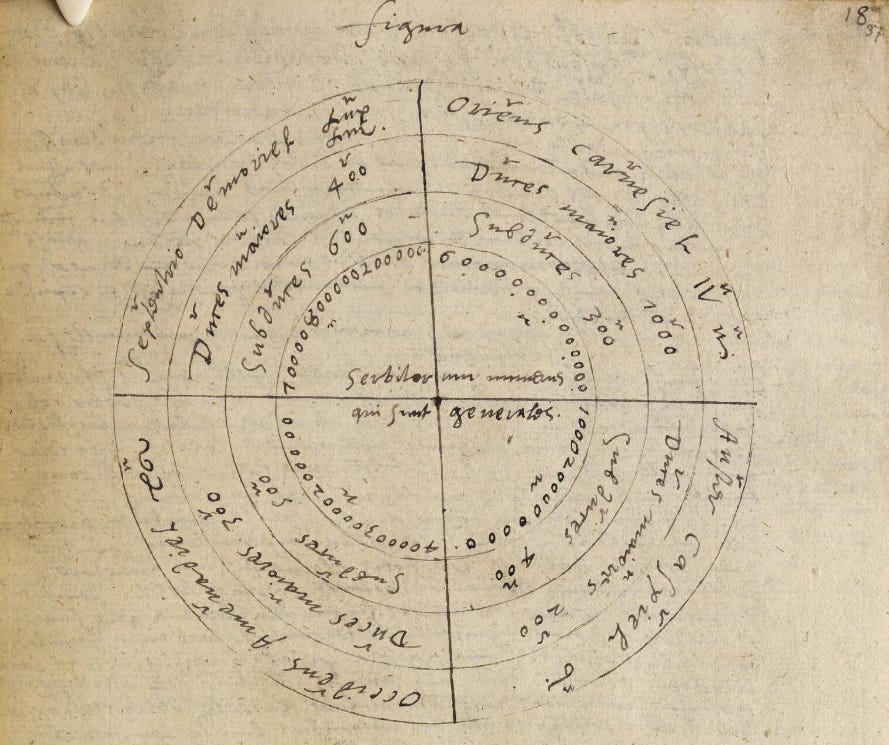
Johannes Trithemius is known as the father of cryptography, and his Steganographia was a manuscript of charts and symbolism (stenography being the concealment of information within information, objects and other mediums) possibly relating to the souls journey through the spiritual realms. The above was copied above in the hands of one John Dee. (CC0)

Any study focussing on the core bead of foundational mythology will point to the object’s sheen of symbolism. Semiosis, the space where symbolism compounds into forms of meaning, is also a through-line to the metalogical. Whereas symbolism embedded within the structure of mythos suggests a distillation process has taken place by condensing and encoding very real observational data into an interpretable and transmittable symbol system, it can be argued that some of the input, some of this information into this semiotic space has come from “outside” of our own relatable sensory experiences.17 Way past the superficial narrative, the fancy metaphors and turgid analogies. Information from somewhere further out. If interpreted correctly, this core bead of wisdom becomes harkened at the deepest levels of esoteric orders.
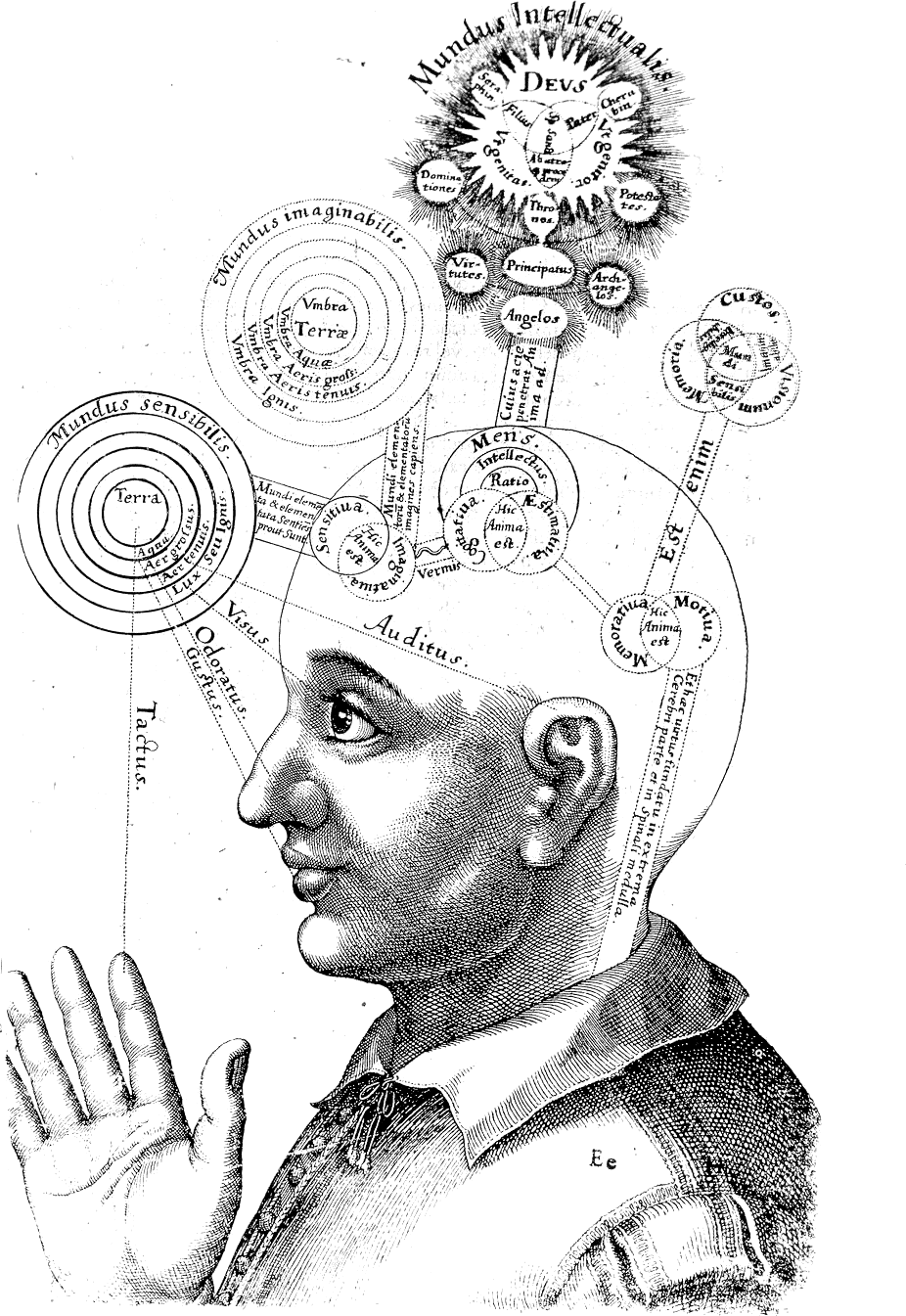
The spiritual mind by Robert Fludd (Source: Public Domain)

Case Study: Rosicrucianism
One example steeped in occult lore is Rosicrucianism. One contemporary sect, the Ancient Mystical Order Rosae Crucis (AMORC), say that their own informational lineage is an extension of Hermeticism hailing from ancient Egypt.18 Others claim heavy influence by sixteenth century Swiss alchemist and esteemed physician Paracelsus. Most agree that The Order was at least partially inspired if not founded by another of Paracelsus’ peers, the mathematician and court astronomer to England’s Queen Elizabeth I, John Dee.19 Whatever the truth, the Rosicrucian network formed under deliberately obscure circumstances around the seventeenth century.20 When tracing latter links back to earlier sources, the first wave of root nodes crested in 1614, primarily through the release of the Fama Fraternitatis, a manifesto-come-mytheme telling the story of a quasi-metaphorical figure “Father Brother C.R.C.”—otherwise known as Christian Rosenkreuz.21 Details and lore aside, in the spirit of structural realism the Fama and the anthropocentric mythemic figure of Rosenkreuz became what we have labelled a thoughtform. A concept—an idea—conjured in the imagination of one or a few individual agencies, stuffed full of symbolism and packed with, in this case, esoteric information, that became at first a metaphorical entity then, after a while, by inhabiting more minds thus controlling more aggregate agency, an entity—a form of hyper-agency—who is fully physical, its body localised by the agential nodes of the egregore network, its reach its furthest host through which potential action based on this initial thoughtform can be taken.22 Real or imagined, thoughtforms, in this case Rosicrucianism, represent the very tip of an idealist-iceberg, one that, regardless of the conceptual mass hidden in the depths, once released into the collective mindspace of Renaissance Europe began to self-organise and propagate into the informational network still active today.23 One reason being that once in-mind thoughtforms selectively recruit other minds. Exactly the reason why it does not matter if you take them real or imagined is because the literal causal influence of a thoughtform remains real (through action) or imagined (through the mind, thought, idea or meme). Through such a process the Rosicrucian thoughtform, generated by the mytheme of Rosenkreuz, was able to further generate sub-organisations leading to distinct but interconnected sects guided geographically distributed but bound by the same values and overarching goal system: to maintain the standards of the Roscicrucian Order by transmuting and transmitting esoteric information to maintain the path of seeking ultimate truth—to hold the shining stone of gnosis. Clearly, Rosicrucianism was and still is an egregore.
When thinking about an organisation, a starting point is to look at their common belief systems. Max Heindel, a Danish-American mystic wrote the “The Rosicrucian Cosmo-Conception” at the turn of the twentieth century. In what is essentially a treatise on the Roscicrucian ideals as he saw them he noted, “The first step in Occultism is the study of the invisible Worlds. These Worlds are invisible to the majority of people because of the dormancy of the finer and higher senses whereby they may be perceived, in the same way that the Physical World about us is perceived through the physical senses.”24 I do not think he was being self-righteous here. At the very least there is a lot more nuance than that. For a start it rings of Jakob von Uexkull’s umwelt. Indeed, his seminal work Umwelt und Innenwelt der Tiere was released in 1909, the same year as Heindel’s cosmo-conception. Despite no obvious evidence of correspondence between the two, the notion of the “sense world” and the “invisible” world came into the minds of mystics and influential theoretical ethologists quite literally at the same time. What sits in this other realm is anyone’s guess. Heindel seems to evoke conditions in which Madden ascribes to the uber-umwelt:
“To understand the Physical World, which is the world of effects, it is necessary to understand the super-physical World, which is the world of causes… We learn nothing of the force itself; we see and hear only its effects… The higher Worlds are thus the worlds of causes, of forces; and we can- not really understand this lower World unless we know the others and realize the forces and causes of which all material things are but the effects.”25
Aristotle believed “The universe may well be due to spontaneity” but he also held that “since incidental causes cannot be the ultimate causes of reality: some natural or intelligent agent must exist beyond them as cause.”26 Such a “final cause” is the notion that all events, natural processes, forms are directed by teleology, their purpose, their own end. In modern terms the “Anthropic Principle” says by the very act of being able to make the observation that the universe appears suited for life it presupposes that being the case because, if it were not, there would be no observation from life observing it. Theoretical physicist John Archibald Wheeler is known for calling the universe a “self-excited loop”, where the observation of life at the very tip of the circuitous causative loop closes the circuit by observing the very thing that it sits upon and arises out of: the universe. Was it Sagan who said something along the lines of Life is the Universe trying to understand itself? The systemic connection between observation and intelligence, and intelligence and the universe is thus well established, from mystical murk to scientific inquiries and theoretical thinking.
Then again, mysticism and frontier science have been held hand-in-glove for quite some time. Uexkull himself was influenced by Neoplatonism and Hermeticism, the same information lineages Roscicrucianism orders claim to this day. If science is an iterative loop of empirical observation and experiment, mysticism is an autopoetic chain of intuitive insight and strange occurrences, and yet still both operate through the medium of flow,27 enchantment, and re-enchantment. While noting this will be talked about in the subsequent articles in this series, when looking at William James’ The Varieties of Religious Experience in 1902 and, as he sees them, the “four marks” of a mystical experience: i) ineffability, ii) noetic quality, iii) transiency, iv) passivity, or that of Evelyn Underhill’s five-stage developmental framework: i) awakening, ii) purgation, iii) illumination, iv) dark night, v) union, the structure of transformative practices and unsought experiences becomes much clearer, especially the overlap between mystery traditions like Neoplatonism, Gnosticism and Hermeticism in general. Undeniably, (although many still try), much can be said about the intertwined nature of alchemical practices (ahem, Newton), occults (excuse me, Pythagoras) and esoteric rituals (okay—I said it, Jack Parsons), and the processes of discovery embarked upon by many frontier scientists. As we shall see shortly, the connection has not been severed. Despite the likelihood either side will deny any close affiliation to the other, both undeniably exist on the fringes of what’s possible. Egregores—coordinated agency producing more than agency—and hyper-agency also exist in the same place. Given mystical traditions can be thought of as an extension to the mind, where mind is an integral component in the whole system of Mysticism, it is also important to note that mind is also a keystone component in the very existence of both egregores and hyper-agency. It seems to track that egregores and hyper-agencies both operate in the spiritual and mystical spaces as much as the physical and material ones because both are fundamentally connected to mind and mind is inherently woven into these spaces. Somewhere between physical entity and thoughtform. And what else exists in liminal niches is the very topic we are seeking out now, partly because it proves time and time again to be of profoundly absurd yet meaningful nature, if you can navigate the weeds.
For a system (or embodied entity) to be classified as an egregore it needs to express causality because agency is inherently causal and egregores are inherently agential. Thus, if an egregore is not causing some influence in the environment and/ or to other systems and entities, then it is not an egregore. This does not comment on the degree of subtlety, however. From living beings to completely artificial systems, agents are evolved (or designed and engineered) to cause a certain degree of change to their environment but whether or not the impact of that degree is easily noticeable or very obvious, at least in the short term, is not dependent on the size of the degree. Permit me some agentification. Earth’s magnetosphere is an integral component to the planetary system. Without it, amongst other effects, the solar wind, radiation, flares, would irradiate the surface. It contorts and changes its geometry based on both the external conditions from the solar system and the internal conditions from the geosphere, most notably the geodynamo, Earth’s molten core. To most of life on Earth, even those more integrated with the magnetosphere and other electromagnetically related systems might not recognise the influential effects that they have on it as a result of those systems. In a reductively flawed sense, the magnetospheres agency goes unrecognised to the life embedded within and directly connected to it. Being an aggregate of agency oriented in a certain direction in a given time, an egregore has the capacity for asymmetric causation because of the amount of agency it contains compared to the environment and other networks or agential organisations around it. One reason why it is coupled to hyper-agency. One obvious causal influence of the Rosicrucian egregore was the contribution to the intellectual ecosystem that produced the still well-regarding “Royal Society” in the United Kingdom. The term “Invisible College” (which will resonate with many due to the poignant UFOlogical connotations) became widely associated with the meetings of natural philosophers at London and Oxford. Heretical thinkers of the time who seeded the more formalised and since established “Royal Society” in 1662. The name “Invisible College”, as it turns out, was taken from the Rosicrucians, who themselves self-identified as the “College of Invisibles”, a network of individual agents, some of them potentially hyper-agential in their own right, placed throughout various regions of social strata, who also shared common values, beliefs, goals, perspectives and thus working models of reality.28 But more importantly still, in The Order’s own words, “The thoughts attached to the real desire of the seeker will lead us to him and him to us.” Making clear that Rosicrucianism places faith in the influence of the founding mytheme, that the sphere of influence it carried would spread to those who need to join, attracting like-minded agents, foregoing top-down recruitment for bottom-up self-selection. Rosicrucianism became a self-replicating, self-propagating, self-editing mytheme because it inhabited and connected otherwise disparate minds through the various thoughtforms branching from it.29 Admittedly this is in slight contradiction to the earlier statement that thoughtforms act as a recruitment structure to “selectively recruit other minds” vs the “self-selection” quality mentioned moments ago. Aside from brushing it off by saying neither has to be mutually exclusive, if we follow the chain of causality thoughtforms generated by a given mytheme spread by inhabiting mindspace that has the preconditions necessary for whatever that structure held. In this sense, the selective recruitment is a self-selective process in a way. Unless one has a predisposition for these beliefs, values, ideas, then it is highly unlikely the thoughtform will be able to “stick” to the mindspace. In a rather crude analogy, the moth does not have to be attracted to the flame; either it flies near it and decides to go closer, or it flies on by without a second thought. But when the right moth gets close, the heat from that flame becomes irresistible. Our minds are the predisposition, the self-selecting under the right conditions, in this case, proximity to the right thoughtform. Selection is through the Self.
The reason Rosicrucianism proves such a fruitful model to study is because it encapsulates both our tensions: “game theory” in the sense that this network expanded in influence through strategic decision making by people who only constituted parts of the distributed whole, from Renaissance-era Europe, where influential movements shaped the Age of Enlightenment early modern eras. Ensconcing tight control over its own unravelling narrative by active choice and logical reasoning. Yet “re-enchantment” is everywhere throughout the entire Rosicrucian narrative. It is foundational; as it turns out, a core tenant of The Order is attempting to commune with “higher beings”, beings in a hierarchy of other intelligences sometimes penned under differing names (like spirits, angels, Djin, Devas and, if you are Greek or Patrick Harpur, daimons). Each existing within what, in 1909 Rosicrucian scholar Max Heindel called a rich ecosystem of Rosicrucian Cosmo-Conception. The world view where agencies exist in many more spaces all around us than is easily perceived is one core element to the UAP-question. Vallée reminds us it is a metalogical stance; prima facie nonsensical, yet symbolically meaningful. The belief that,
“Not until the archetypal model has been changed can the Intelligences which we (to hide our ignorance concerning them) call the Laws of Nature,” bring about the physical conditions which alter the physical features of the Earth according to the modifications designed by the Hierarchies in charge of evolution,”30
is not exactly the popular concurrent paradigm. It is outside of regular conventions. Yet it remains stepped in symbolic value. And in some cases, certainly when aggregated as a net-effect, asymmetrically causally influential. Resulting in a flip. A fork in the timeline. This article is certainly not the first time “Rosicrucianism” has been pattern-matched to both “egregore” and “game theory”. More interestingly still, neither is it the first time “egregore” or “Rosicrucianism” has been associated with the concept of “angel”. But hold that thought, will you.
Rosicrucianism also ticks all the prerequisite boxes for being a hyper-agent. Robert Vanloo states that earlier 17th-century Rosicrucianism had a considerable influence on Anglo-Saxon Masonry, wherein Freemasonry became arguably the most powerful civil-society network of the 18th and 19th centuries. By the early 1700s Freemasonry had begun to absorb many Rosicrucian ideas, and early Masonic thinkers saw themselves as heirs to the “Invisible College” with some 18th-century Masonic rites even explicitly labelling themselves Rosicrucian. Scholastic communities during the early seventeenth century became tied to The Order’s wider network. Household names in broaching scientific paradigms like Sir Isaac Newton were obsessed with alchemical work and occult-philosophic thought, heavily influenced by Rosicrucian manifestos. Historian Frances Yates’s traced the influence of the Renaissance Hermetic-Cabalistic information lineage through the early 1600’s and documented its impact on figures instrumental to the scientific revolution.31 In the most basic sense, the sum of the whole Rosicrucian movement is way more than the sum of its individual parts (or people—or agents—or minds). Between the years 1614-1620, about 400 manuscripts and books were published discussing the Rosicrucian documents. Think about it: 400 manuscripts from three anonymous pamphlets published in a small German principality... In other words: a small initial input ended up reprogramming the operating assumptions of European intellectual life, seeding institutional forms out of which modern scientific paradigms burst forth, the output becoming a combined belief and value system able to inject its structural metalogic into other such esoteric networks, Freemasonry, and blending with Gnostic roots, its view on scaling cosmic intelligences subtly undercutting Enlightenment thought. Angelic holarchies are part of the modern religious undercurrents as much as they were contemplated in the ancient foundation myth.32 What’s more, the disproportionality of input to output is indicative of the asymmetric causal influence necessary to classify the “hyper-” prefix. Thus, Rosicrucianism is an egregore. Maybe not right now, but Rosicrucianism has also been hyper-agential. The meaning in this absurdity being it seems many mystery traditions, occult practices, esoteric ritual, represent wholes that are way more than a sum of their parts. Certain processes, conducted in a certain order, under specific conditions, often using unique but nondescript objects, whose combinatorial output is believed by these traditions and mythology to connect our mind to other agencies.
The reason I point this out is to make the case for egregoric structures being not only something deployed by hyper-agencies (because of their effectiveness in controlling causal influence) but a structure that is fundamentally connected to the very existence of a hyper-object, a phenomenon also accounted for in mystical, spiritual, hierophanic, and theophanic experiences, events, and contexts. Coincidentally, this also pattern-matches to the definition we arrived at in Part 1 for UAP.
Hyper-agency and egregores couple UAP to divine encounters. The mechanism is one primarily of control and secondarily for information (symbolic) transfer through mind-mind connection.
As a unit of objective measure and prediction, the half-life of EGT and game theory breaks down at a steadily-increasing rate when extended out into the liminal spaces necessary when ruminating over things like the UAP-question, Our Lady of Fátima, or UFO of God. The ambiguity and metalogical conditions of the subject matter often lack the necessary structure for game theoretic assumptions to stick. I mean, one could literally “grid” the agential spheres of influence as proposed in 1.2. However, this serves as nothing other than a confirmation of the point that something hyper-agential and egregore-like was present in a specific location over a specific date and time. Because we are ultimately imagining the (re)connection of mind—mind (however abstract and obscure this may be), and because even the simplest of minds are so unique, and because we then have to factor in the collective mindspace of living structures like egregores and the complex nature of hyper-agency as well, standard testing parameters quickly erode, breaking down in need of less conventional replacements. We need to stop thinking of ourselves as standing on an island of cognition in a sea of unintelligence. Instead the truth may be far closer to occupying a nook nestled amongst a cascading flow of intelligences.
Dionysius the Areopagite, a sixth century Syrian mystic inspired by Neoplatonic philosopher Proclus envisioned “a differentiated consciousness appropriate to each kind of organization.”33 Each scale where a substrate organises itself through active patterns experiences a level of connectibility to other intelligences and agencies within these various levels of spatial scale. That is a good place to start. Not quite scale-invariant Panpsychism, but not too far off. With that in mind, more concurrently in 2022 the “Technological Approach to Mind Everywhere” (TAME) framework was forged from the mind of high-level synthetic biologist and Tufts University professor Michael Levin.34 Specifically designed with understanding communication between “multiscaled competency architectures”. Connecting cognition across various scales. In Levin’s own words,
“The TAME framework pushes experimenters to ask “how much” and “what kind of” cognition any given system might manifest if we interacted with it in the right way, at the right scale of observation. And of course, the degree of cognition is not a single parameter that gives rise to a scala naturae but a shorthand for the shape and size of its cognitive capacities in a rich space. The second pillar of TAME is that there is no privileged material substrate for Selves. Alongside familiar materials such as brains made of neurons, the field of basal cognition has been identifying novel kinds of intelligences in single cells, plants, animal tissues, and swarms. The fields of active matter, intelligent materials, swarm robotics, machine learning, and someday, exobiology, suggest that we cannot rely on a familiar signature of “big vertebrate brain” as a necessary condition for mind.”
Through the systematic and experimentally-backed TAME framework, Levin and colleagues are making the foundational claim that all known cognitive agents are collective intelligences composed of parts that are themselves agents. Cognition, a prerequisite for agency, exists across multiple scales of organisation. If this is true, frontier science is telling us “Selfs” are everywhere. Meaning “Minds” are everywhere too. Indeed, one key tenet of the TAME framework makes clear:
“The core of being a Self is the ability to pursue goals. Selves can be nested and overlapping, cooperating and competing both laterally and across levels. Each higher-level self deforms the option space for the lower level Selves, enabling them to follow energy minimization to achieve outcomes that look inevitable and simple at one scale, while serving intelligent goals at a higher scale.”
I’m not even commenting on intentionality, but as a clipped quotation the above could be out of a twenty-first century reboot of the 1614 Rosicrucian pamplets. I know I am being dramatic, of course, but in all honesty the comparison between mythology, UAP, esoterica, hierophany, frontier science, and spiritual experience is quite startling when it comes to one thing: mind connecting to mind. Levin’s “multiscale competency architectures” (MCAs) are stacked systems of interrelated substrative teleology. Finding consilience between the old and the new, back in the space of mysticism some of those minds is assumed by the other (us) to be “higher” and “lower”. But this does not need to be a moral position. Bioanalogy shows us that the “top—down” causative loop stemming from the action of a person standing too long in the sun causally influences their skin cells—structural organisations at microscopic bio-chemical and bio-physical scales (which Levin and many other top scientists say are “cognition” bounded by bioelectric “cognitive glue”35) and it also shows us how open causal loops, the decisions and goals of the individual cells and cellular networks influence the entire individual “bottom—up” when cellular networks regenerate or mutate. However the analogous half-life breaks down, becoming metaphysical rather quickly when factoring in that our skin cells (individual or networked) may indeed lack a “belief system” in order to interpret us, the larger cognitive structure they are embedded within, as a “higher mind” (or larger cognition) it is nestled within. Neoplatonism, Rosicrucianism, Gnosticism, Hermeticism, all seem to suggest this so. True, it may be a stretch to equate “larger cognition” to “higher power”. But is it really?
Frontier science shows us that our own body, as well as the environments around us, contain sets of cognition, just at various scales within various substrates. In the future, frontier science might tell us that cognition scales outside of our planetary bounds. Cognition becomes scale-invariant. Just like the decisions of our cells become causally influential actions effecting the next mind(s) up in the chain of structural organisation in space, both us and our cells, our cells and hives, swarms and societies, (living) tissue and artificial substrates all express cognition and agency, they become in quite a literal sense a form of individuated “mind” and a nested, collective “mind set”. In my opinion the fact that there are minds all around us that we can knowingly, unknowingly and mistakenly communicate with is a fundamental component when thinking about frontier science and the UAP-question writ large. It is a case of lower-level cognition brushing up against higher cognition, or vice versa.36 Just like our cells are a scale of mind—Selflet— embedded within us, fractal logic implies that we are most likely a Selflet embedded within something else. And, even within our regular conventions, we clearly are: cities, crowds, groups, tribes, teams, are all examples of a single cognition embedded within a larger one. Shared history, mythology, principles, stories—these are all binding agents. In turn our senses, our umwelts, our psychitecture, our minds internalise and reinforce these systems of thinking about and interacting with the environment. In some cases minds can end up generating, initiating a connection to, or attracting something more than itself. A Selflet from another spatial niche. Another structural domain. A situation where both the cognitive agents and collective intelligences that make up diverse arrays of “Selves” actually exist all around us. Thus, it does not take much to pattern-match the egregore concept—a thoughtform that boils up from idea to meme to thoughtform to mind to body until real-world action is enacted through mind—mind connections—to what Levin calls the “scaling of Selves”—a pattern of cognition that starts somewhere near the bottom of structural scales, and the top, and the middle, thus suggesting cognition, teleology, permeates all scales. It also is very clear how this tracks to UAP.
Control System vs. System of Re-Enchantment
Taking a step back to a spiritual place, the most simplistic take on the Paracelsian doctrine underlying the Rosicrucian Order states that the human being is a microcosm reflecting the macrocosm.37 The same active patterns appear across scales of organisation and also across different substrates.38 Fractal logic suggests minds branch into and rub against other minds, top—down, bottom—up, side-to-side. This is what the TAME approach suggests when it talks about persuadable “minds” existing across a mirrored spectrum. There is a certain symmetry. Like fractal logic. It does not make sense, but in a way that does. Which in and of itself is metalogical because the point of a hyper-agent and egregore is asymmetric influence. But the as above so below doctrine is so fundamental to occult lore and mystical information lineages that the symmetry implied in the statement seems to hint at the symmetry being just as important as the inbalance being thought about more game theoretically.
Not to hammer on a superficial comparison of Rosicrucian idealism and the current pioneering Field of Diverse Intelligences but Dee’s development of his system of Enochian language between 1582—1589, (described, coincidentally, as the “Tongue of Angels”) consisted of a protocol of symbolism and ritual used to commune with angelic intelligences, including the use of a “scrying mirror” made of obsidian originating from Pachuca in Mexico.39 Indeed, one method of opening communication with “angelic” (in other words, non-human) intelligences was to use scryers who could enter into altered states of consciousness and perceive information from niche places (like special objects, known by the Neoplatonists as synthēmata). Other systems designed to enact intelligible communication with angelic entities can be found with early theologians like St. Thomas of Aquinas, Hildegard of Bingen and Dionysius the Aereopagite, who all lived between the 5th to 13th-century and were each known in their own right to have a special relationship to what amounts to forms of angelic agency.40 Whatever the case, parallels enable this to be (sorry—another “re-”) reinterpreted as an early attempt to identify the correct position of oneself within what TAME calls the “persuadability axis”.
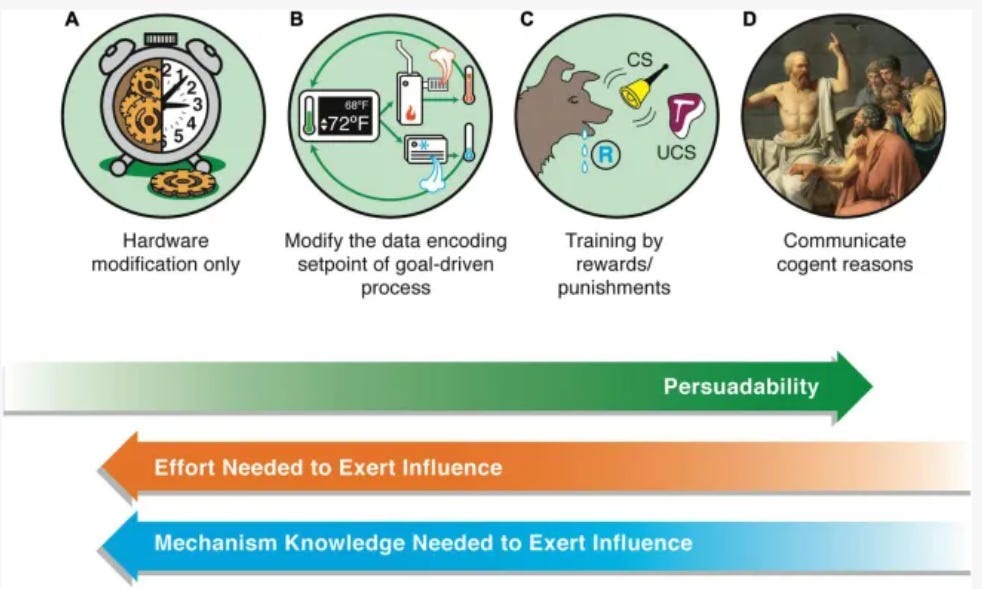
“The axis of persuadability. A proposed way to visualize a continuum of agency, which frames the problem in a way that is testable and drives empirical progress, is via an “axis of persuadability”: to what level of control (ranging from brute force micromanagement to persuasion by rational argument) is any given system amenable, given the sophistication of its cognitive apparatus?” (Source: Levin, 2022).
However, the conditions forming our parallel axis are not just bioelectric systems and substrates and the outcome is not necessarily finding novel ways to use science for human-nature harmonisation like in frontier science.41 When swapped to reflect the work of influential esoteric figures like Dee, Paracelsus, and even more so the wider Hermetic and Rosicrucian tradition, instead the axis reverberates with esoteric magick, whispers of ritual practice and certain protocols. Yet the primary aim remains the same: creating a connection between our scale of intelligence and another. Learning that “egregore is Greek in origin and is derived from égrégoros, meaning “wakeful” or “watcher” and that the first appearance of the “word is found in the Book of Enoch wherein it is described as an angelic being”, hopefully the connection between Enochian Language and Roscicrucianism as an egregore and hyper-agency, in tackling and the UAP-question becomes a little clearer. Especially given that, even if you discount Dee and Kelley as fraudulent tricksters or undergoing something phenomenal but wholly explainable in a materialist sense, this does not account for the countless people who have since, by reciting Enochian language, attested to its effectiveness in contacting something—spirits, angels, daemons and otherwise abstract minds. Esoteric researcher and founder of the Institute of Hermetic Studies Mark Stavish points out that in mystery traditions an “egregore is more than an “autonomous entity composed of and influencing the thoughts of a group of people”; it is also the home or conduit for a specific psychic intelligence of a nonhuman nature connecting the invisible dimensions with the material world in which we live.”42 Whether or not the intelligence is indeed psychic or derived from some other abstract substrate is beside the point. The fact that mystery traditions as well as frontier science seeks a means—a conduit—for connecting to intelligences across scales and substrates which are for the most part all but “invisible” is the part being pointed to. Despite the contrasting methods, regardless of the difference in underlying belief systems and value structure, the goal hierarchy and real-world action are oriented in the same direction: mind—mind relation.

John Dee’s sacred technology, obsidian from just outside of Mexico City, near to the Tula Temple and not far from the sprawling site of the Temple of the Moon and Temple of the Sun and Teotihuacan. It was one of his tools of choice for attempting to communicate with non-human agencies.
(Source: The Trustees of the British Museum via Christina J. Faraday)
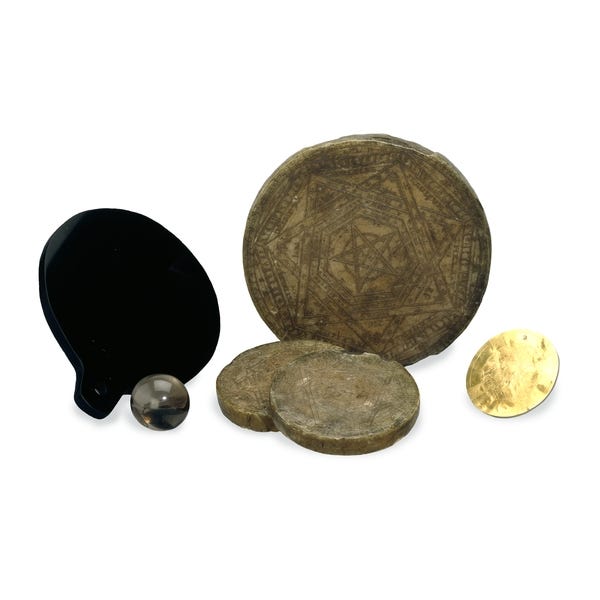
Object used in occult ritual and other processes invoking communication with non-human intelligences, in this case spirits and other spritual entities used by John Dee during and after his time as court astronomer to Queen Elizabeth. (CCA BY-SA 4.0)

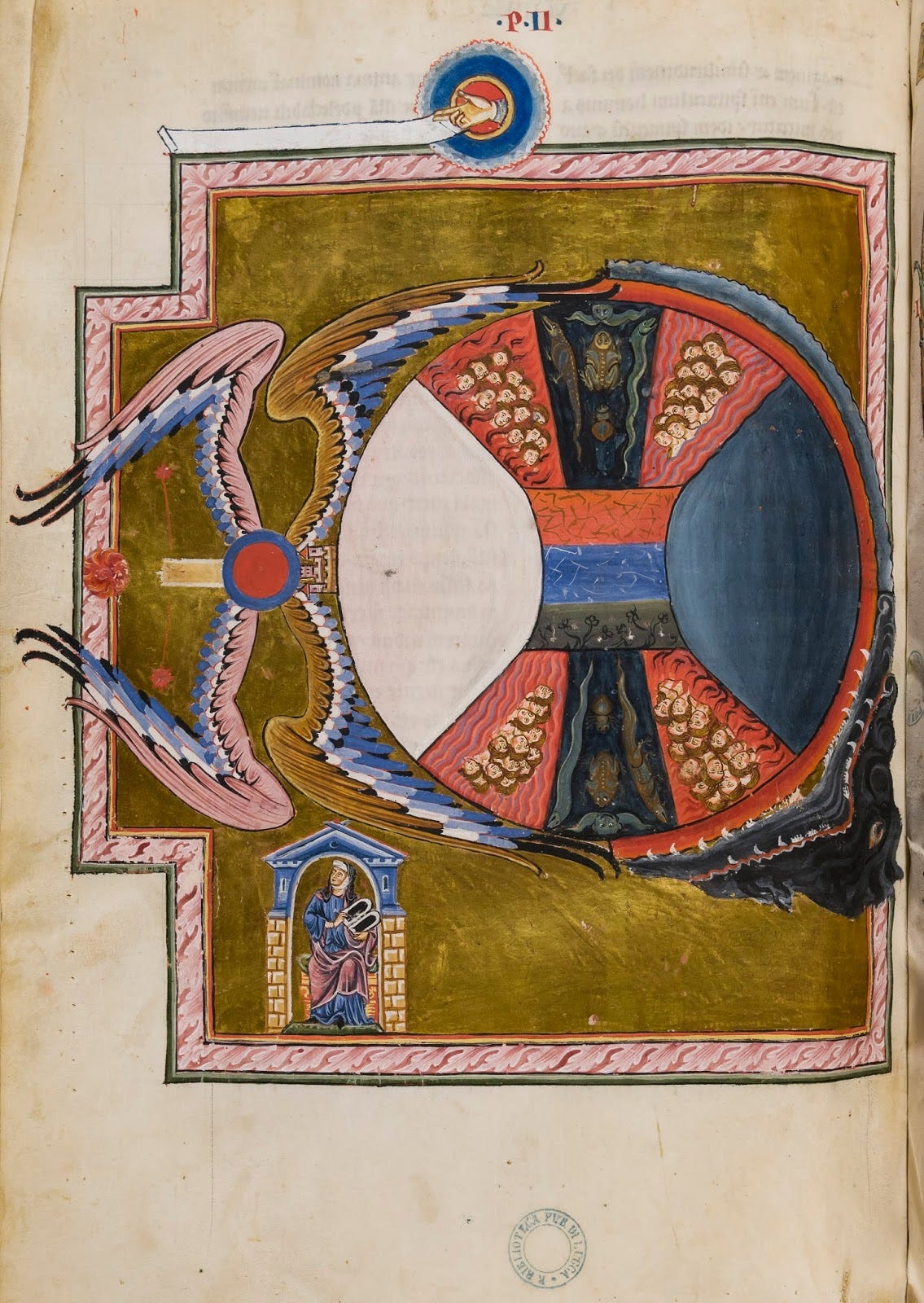
(Source: Book of Divine Works, Part 2, Vision 1: The Parts of the Earth: Living, Dying, and Purgatory, by Hildegard of Bingen)
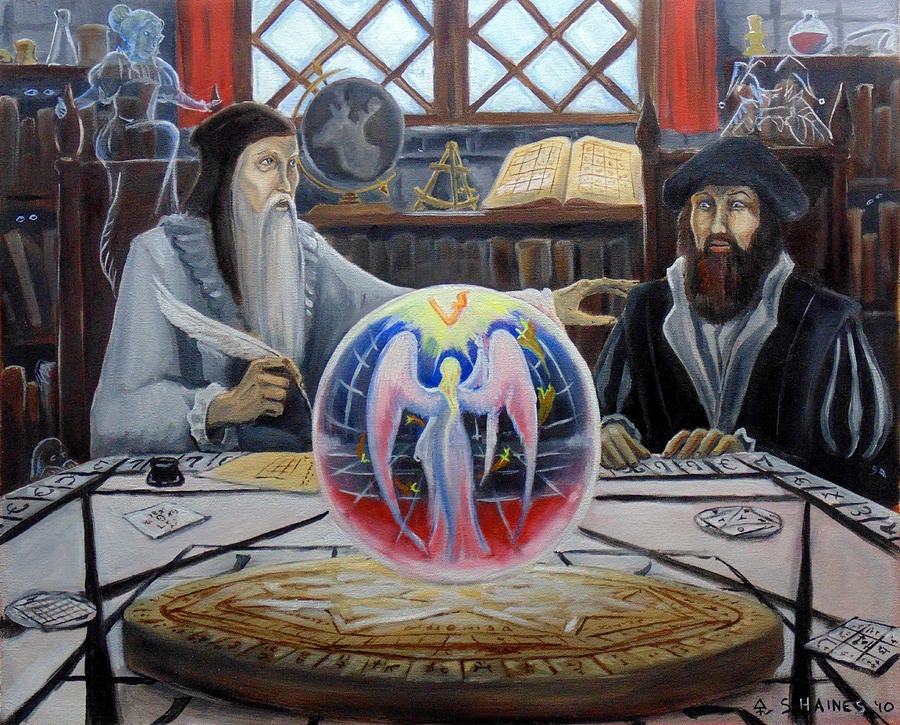
“This picture illustrates one of the most significant events in the history of Ritual Magic. In it, Doctor John Dee and Edward Kelley look into the “shew stone” to receive communications from the angelic realms.” (Reproduction Painting of John Dee and Edward Kelley at MWM)
Hildegard’s painting quite literally displays a medieval rendering of multiscale cognition, where souls (small agencies) sit inside fire-bound regions (mid-scale ascension conditions) inside the cosmic wheel (large-scale order) inside the divine speech (the assumed highest order), bound together by angelic operators (mid-large scale agents) who seem to span all scales. Look at the dark central panels. There be demons; reptilian figures, small, clawed, who actively participate in the testing of souls. These are not metaphors for Hildegard as much as they were real cosmic agents with their own teleology, constrained by but operating within the divine order. The great wheel on the right is the interior of the earth, its hidden structure, organised by the cardinal directions, the winged figure on the left, with multicoloured pinions and the concentric red-and-blue disk at its heart, is an angelic intelligence, an operative power that has a hand in turning the cosmic wheel. Angels not purely aesthetic, but causally meaningful. A substrate by which divine intention becomes a natural process. In much of the mythology it is clear this is done through persuasion. John Dee’s scrying mirror, and its mysterious Aztec origins, is just a classic wink from the imaginal, a mystical marker for the desire to connect with other intelligences through esoteric means. Through the infamous scryer Edward Kelley, gazing into mirrors, water, and more famously crystal balls, but also the combination of other processes like fasting, long incantations and mantras, the use of certain herbal materials, alchemical substances, the arrangement of special and meaningful objects, meditation, entering flow, creating, this is what led to the intended communion. Persuasion followed. The question of who was persuading who is left to the imagination.
If the relation between cognition and the persuadability axis is still not clear just ask yourself the following: how easy am I to persuade? The latest research suggests cognition is independent of substrate, and thus the door opened for an interface between us and lower-scale agents nested within us. One way we do this is by learning their “language.” Levin famously highlights bioelectric signals within cellular gap junctions and voltage-gated ion channels is our cellular language to learn. Your answer becomes indicative of your cognitive positioning. Not in a judgemental sense, but in fact you can be persuaded or even “tricked” because you have the underlying cognitive architecture capable of being manipulated in the first place. In other words: can you talk a rock into buying you a drink?43 Through such thinking, when scaled up and down, modelled and experimented at a high level of technical ability teams of scientists have recently been able to successfully “communicate” with cognition at lower spatial scales to us (ie. our cells, cellular networks, tissues, as well as bio-synthetic biobots, anthrobots, xenobots) by thinking about ways in which they can be persuaded to perform certain actions or to follow certain goals. Amazingly, this had led to breakthroughs in the way we develop cancer treatments and even limb regeneration. It works because these lower level cognitive architectures are robust enough and feature enough integrated information to be persuaded into making decisions and taking action on behalf of the larger cognition (which according to Integrated Information Theory (IIT) could be in part the measure of “small phi” or ϕ in the most irreducible component within a given system). It just so happens that in the examples from leading experimentation this lower-scale cognition is embedded within a larger one—us. Thus, because we learn to communicate with cognitions, and ultimately agency nested within our own bodies and minds, if we had our Neoplatonic hats on, following the maxim of as above, so below, would it not follow cognitions, intelligences, agencies at higher-orders than us may well attempt the same to us? I’m agnostic there, but it makes metalogical sense. Whether or not this applies to our relationship with angelic agency is neither here nor there, because other possibilities are just as likely (e.g. larger-scaled cognition simply exists at a larger structural scale independent from our own, like the cells within the bacteria in the soil outside exists near your own personal larger-scale cognition, just not embedded within it like your own immune cells are).44 Whether embedded or not it does not seem to change the cause-effect influence of the agency in question. According to John Dee, Edward Kelley, Neoplatonists, theologians, and first-hand experiences throughout the ages, we can similarly be persuaded by higher-order intelligences. If at this point one takes a Hierophanic Realist stance, theological evidence suggests angels persuade us. Whatsmore, however, it seems we can also persuade them.45 If thought about through the framing of “mind—mind connection”, or more specifically one agency seeking a relation to another by opening a line of communication across scales, UAP and angelic appearances alike become far less shocking and a whole lot more intuitive: minds reaching out to other minds.
The Miraculous
Reinstating a sense of wonder and awe through miraculous experiences indicates, at least to some degree, a prior loss of the original enchanted state of being. It may come as no surprise that the process of enchantment (as well as the loss of it) is pivotal to the human condition. Permit me an analogy. Within a matter of years Santa Claus goes from a very excitable reality to a silly childish belief then, some more years later, when a parent sets out to stoke the wonder and awe of their own child, the process becomes a state of, well, re-enchantment. One loop of enchantment closes as another begins.46 Just in case I am losing you: the bonds between minds are everything, even down to the essence of re-enchantment. Whether those minds are corporeal or mercurial is the factor that will then obscure any accurate read on the specifics of the relation. What’s more, it becomes clear that the driver of the two mythically young47 yet narratologically potent cases in question here in the subsequent articles in this series: “Our Lady of Fátima” and the “UFO of God”, is the experience of a person or a group of people returning back to a relation, a connection, a bond—a syncretistic link that, if not them specifically—we—as a collective species have strayed from or lost, that connects our agency, our minds, to other agencies and higher minds. The crux of re-enchantment is a reconnection to another state of being, a connection largely gone astray yet yet one in the act of returning. By re-belonging, re-enchantment becomes the field from which relations regrow and repair.
Now, all the “re-’s” aside, feeling connected to another however abstract or absurd the interaction (or however abstract or absurd the other), the process of undergoing a relation or forming a bond remains a theme consistent throughout the entirety of both the UAP-question and the spiritually-related cases involved in this study. On the nature of that “other”, philosopher William Vallicella permits “everything is either a mind, or a content in a mind, or a physical entity, or an abstract entity” and thus, “given that [the One] is neither abstract nor physical, what we must conclude is not that [it] is a mental content, but that [it] is either a mind, or more like a mind than anything else.”48 Hence, the most reduced basic unit of thinking about the link between a) humanity and b) a divine pattern of The One, becomes: “mind—mind”. Not to reduce an infinite equation even further but this is exactly why the egregore element is so fortuitous: it superimposes the study of i) game theory, ii) UAP, and iii) re-enchantment onto a framework of iv) “mind”.49 If you think back to our Rosicrucian egregore example, what encourages the bonding of mind—mind more than a thoughtform? An active structure which couples otherwise disparate minds through a shared vision, intent, purpose, orienting a collection of minds towards a shared goal. As relating to other minds go, our species is well-versed.50
True, we ebb and we flow. Not faultless. (Certainly not faultless.) But collectively we do alright when it comes to connecting our minds together.51 And it is my assertion that that feeling of relation cannot be ascribed nor understood through game theory alone. Sure, game theory can measure the causal impact, and hope to model and predict this in the future. But the mind is also part of the “imaginal” system.52 Mind is part of phenomenology. Being the space from which symbolism, fiction, vision, poetry, magick, myth, folklore and the like, all stem from; rooting his extensive work in Arabic Islamic philosophy, especially the mystical thought of the Andalusian Sufi master Muhyiddin Ibn Arabi, the intermediate world between the intelligible and the sensory is what French philosopher Henry Corbin labelled the “imaginal realm”—a wholly transjective space of agential, actual, yet not completely literal causes and processes, objects and entities. Existing in an Idealistic plain somewhere between objectivity and subjectivity and thus becoming something adjacent to but ultimately outside of game theoretic predictions alone. A long time ago Carl jung famously noted the coupled Idealistic—UAP reality, and more recently Bernardo Kastrup has also done much to lay a foundation. Instead of relying on mathematically tracing the strategic decisions of “agents” whose success relies on the choices of others, a set of moves in the strategic space gives way to a mode of being in the ontological space. It is from such a space that wonder and awe bubble and arise. That spark of magick when the whole world turns on the head of a needle, where things fall together in such a way as to define the very laws abiding them. From this transjective soup miracles perforate the membrane film.
Accordingly,
i) the state of re-enchantment,
ii) Our Lady of Fátima & the UFO of God,
and
iii) the overarching UAP-question,
do not just passively lap at the shores of “thauma”… they are the very moon whose orbit churns the miraculous tide. It is because of the very process of re-enchantment that one may be open to experience a miracle; it is because of the content of these cases, their events, actions, meaning, that wonder is dissipated through myth and narrative; equally so, as experiencer studies suggest it is because of UAP that so many are left in awe of the potential reality we sit so closely adjacent to. All that to say game theory alone is simply not fully equipped to map the decision trees branching off from such miraculous experiences and possibilities.53
Not to say that human agents or UAP do not act strategically. That would be missing the point. And probably a little naive. Clearly, as many researchers, historians, investigative journalists and documentarians such as Jacques Vallée, Richard Dolan, Leslie Kean, George Knapp, Jeremy Corbell, Ross Coulthart, Michael Shellenberger, Steven Greer, John Greenewald Jr., Robert Hastings, Mark Pilkington, Jesse Michels and UAP Gerb have each point out, UAP (as well as human military—intelligence organisations) operate through a distributed control system of information and energy enabling them to manipulate agents and environment with relative ease. Military—intelligence organisations, including all the well-renowned “three-letter” and “alphabet” agencies you can think of can all be considered hyper-agents. Just as UAP can. Just as those objects of divine power are. Indicative, at the very least, of dense causal agency permeating all strata of this scene. I’m not here arguing the moral position. I’m not here equating them all as the same thing. The only reason hyper-agency and egregores were selected in the first place is because they are a significant part of what is left when whole chunks of UAP data is filtered and condensed. True, both concepts are reflected in sociology and geopolitics. Both are also featured in ancient myth, esoteric ritual, mystery traditions and some other very absurd phenomena. Both, ultimately, become a placeholder for agency capable of asymmetric informational control and causal influence wherever on Earth they show up.
Hyper-Agential Behaviour: Contemporary Contact/Control Attempts
Okay, full disclaimer: this next part should be taken tentatively. Requiring a massive leap in priors, perhaps in lieu of the way most people tend to look at national institutions and the agencies charged with protecting them and their countries interests. The sources are murky. The context even moreso. If that sounded obtuse, it was so by design. Everything about such agencies is obfuscated. Criss-crossed with lines of Vantablack redaction. Obscured behind veneers of photochromatic glass and charades of arrows pointed in every which way imaginable. In part that is because this is the very nature of this domain. The information space. Or more precise: controlling the information space. The modus operandi of global military—intelligence agencies.
Despite the fact that anyone who has at least heard of War of the Worlds, Independence Day or Men in Black can realise the intertwined nature of national security operations and UAP, it is still an awkward topic to broach.54 But when this is directly intertwined with the notion of seeking a mind—mind relation, despite representing some pretty sinister corners and the irrespective of the rather ambiguous provenance, let’s hear it out. We are in the market place of ideas, are we not? If you want to take my lead, it’s going in my interesting-if-true basket.55 Alright, here we go.
Carl Andreasen, an independent, boots-on-the-ground researcher connected to ongoing investigations at the infamous Skinwalker Ranch and lesser-known Mount Wilson and Thunderstrike Ranches has drawn some quite intriguing and outrightly creepy (if true) conclusions from information provided by former U.S. government intelligence liaison and Pentagon whistleblower Matthew Brown (Invisible Frontiers), in addition to the now missing Air Force General Neil McCasland. For context (and if these names are all new to you then you may well need even more context than this humble work can provide), Brown is a former United States national security official who had respected careers at the DoD, State Department and DARPA56 and is one of the latest in the what feels like continuous rolling wave of American “whistleblowers”. Blowing the siren on what they were sworn to secrecy to maintain. To observe, collect, analyse, determine, speculate, to “be in the know” about the UAP-question. Now letting the information go public. All in the name modern “disclosure”.57 Brown’s public emergence in 2025 came through combined efforts from investigative journalists Michael Shellenberger, Jeremy Corbell and George Knapp. The focal point being that Brown is the name behind the notorious Immaculate Constellation document that revealed (once again) the alleged Pentagon program for collecting and sequestering UAP imagery. As it turns out, he penned the report that was submitted to the record of the November 2024 U.S. Congressional hearing.58 Having also submitted a long list of connected names and companies involved in the legacy UAP projects, Brown was clearly clued in to what was going on behind the scenes of the frosted panes of military—intelligence. Andreasen set his aperture on Brown’s cryptic social media posts since. Long story short, these messages have been symbolically interpreted as implying highly unique, quite unbelievable use-cases for the latest AI systems embedded in military—intelligence operations.59 And here is where the recently and still missing Major General McCasland comes in. The full claim being that these AI systems act like “Enochian Magic”. In other words, military—intelligence programs are using them to “initiate” contact with other intelligences. According to researcher Peter Levenda and former Blink 182 singer and long-time avid UFOlogist Tom Delong, Major General McCasland, part of a small group of high ranking officials who provided key information regarding UAP, said to look no further than ancient Greek mythology, specifically the story of Prometheus,60 when trying to understand the broader strokes. Without diving into speculation as to what that could imply, the point is that leading hyper-agential figures in leading hyper-agential organisations are i) turning to mythos as metaphor, ii) hinting to a connection with other hyper-agencies, and iii) possibly using artificial intelligences to bridge this gap.
John Dee—co-creator of the Enochian language—was interested in communicating with higher forms of agency hundreds of years ago. Frontier science is currently pursuing this goal in medical and cognitive domains. And advanced information-collecting intelligence agencies61 are not just actively seeking knowledge about other intelligences, they are actively seeking a relation to them. Twos a company, threes a crowd. According to Andreasen’s testimony and speculation, these AI-infused systems, traditionally utilised in highly kinetic theatres of military operation for tactical prediction, creating and assessing complex decision-trees and accurately modelling possibility spaces where death sits around every corner—yes, these AI systems—are also being utilised by some highly classified subset of the national security apparatus for another purpose: communicating with other intelligences. At least, that is what is being reported. I know, outlandish speculation. But, believe it or not, this might not be a new phenomenon. It has been a directive before.
In June 1983, Lieutenant Colonel Wayne McDonnell of the U.S. Army sent an internal report to the Commander of U.S. Army Operational Group (INSCOM) to evaluate whether the Monroe Institute's Gateway Program had genuine value as a strategic tool to be leveraged in the world of tradecraft and war. Bob Monroe’s training system included the combined use of “binaural beats” (called Hemi-Sync) and specific visualisation and mentation protocols to alter a subject’s state of consciousness for such purposes as remote viewing and out-of-body experiences—both potential sources of non-local intelligence gathering. Or so the thought went. In his report, McDonnell “ascertained that human consciousness is able to separate from physical reality and interact with other intelligences in other dimensions within the universe…”.62 Now, the point is not whether or not this is true; it is the fact that for whatever reason the military—intelligence agencies (for certain in the U.S. and in USSR at the time) were in some way attracted to processes envoking the connection to higher-level, non-human agencies. If taken at face value the Gateway Program is one such process. Put it in that basket. That was in the 70s and 80s. What about from last year? Another in the wave of whistleblowers, former U.S. Air Force special operator Jake Barber,63 alongside other ex-special forces and military—intelligence personnel, broke their story in January 2025 to Ross Coulthart on News Nation. The connection this has to actively seeking communication comes from the fact that ever since the concept of “psionics” and “psionic assets” have been the talk of the town. If this is the first time hearing these terms heed my previous warning but, most simply: Barber, a former special operations rescue pilot, claims to have been involved in what he describes as high value crash retrieval and recovery operations connected to the latest technology and also, (and perhaps even more crazy: deliberately) downed objects and craft related to non-human intelligence (NHI). These objects—these UAP—most famously in Barber’s case an “egg” shaped object, but since Skywatcher’s “living taxonomy” there has been over nine types (or species) of object categorised from observatonial data—display some uncanny characteristics.64 Supposedly stepping right out of this kind of operation is the first-hand claim that these UAP can be called-in by trained human operators… using altered states of consciousness, utilising meditation, dissociative techniques and specific protocols. These are the psionics. Sounds pretty Enochian to me. As esoteric as it gets. Psi being the ability to read “mind—mind” (otherwise known as being psychic). Indeed, multiple of these psionic assets have since come forward and told their absurd-sounding stories yet shared corroborating evidence to back their claims up. Again, either they are all making this up for very little nor obvious gain, or we can chuck it in the basket and keep in mind that, once again, it all boils down to connecting our agency to other non-human agency for a specific purpose. Persuading another mind.65 Connecting mind—mind and entering into an axis of persuasion, however abstract the agency expressed by that mind. That’s the claim anyway. Told you to suspend disbelief.
At face value it seems like a pretty wild claim. If you’ve been around long enough, it probably isn’t. If you’ve been around too long, not wild enough. On our quest to look at UAP mythology and stress test it through certain theoretical conditions it seems that the search has landed on the connection of “mind—mind”. A fundamental element present in the UAP-question. Also present in the Our Lady of Fatima events. In the UFO of God too. In hierophanic and cognitive domains alike.
Regardless:
Everyone, it seems, from the spiritual circle to frontier science to bleeding-edge military—intelligence networks are all converging on the same thing: engaging with a higher mind.
When that other mind could well be hyper-agential, an unconventional cognitive systems, it seems more than trivial to try and understand what it is we are engaging with?66
If actively seeking communication with other intelligences and agencies at differing scales, without thinking about one’s positioning, it is impossible to initiate such a relation. In Levin’s words, understanding “to what level of control (ranging from brute force micromanagement to persuasion by rational argument) is any given system amenable, given the sophistication of its cognitive apparatus” is a way of thinking about minds, and their relatability across various scales. John Dee seemed to be such a seeker. Just framing it in an Enochian structure. So was William James and Charles Sanders Peirce, early pioneers of cognitive and biosemiotic thinking.67 Now, in 2026, seekers range from mystics to ex-military officials to synthetic biologists. We are indeed seekers. Seekers of a rather abstract form of hyper-agency. However, despite the fact that in order to grasp the full agential nature of the diverse phenomena on display in the Our Lady of Fátima, the UFO of God, and the UAP-question writ large, EGT and other tools like TAME can be employed, this is not part of some net-reductionist approach. Far from it. Well—it is not intended to be. Be prepared for equal parts re-enchantment, the shock of true miracle, the flare of spectacular theatre because, aside from my own desire and biases, the prevailing mythos demmands it so.
It seems time to stop asking “what are they?” (objects, craft, visitors) and start asking “what kind of relation is this?” (between minds, across scales, through specific and intuitive interfaces). Whatever it is, it is present in all facets of reality. From the developmental to the mystical, symbolic, to the scholarly, mytho-poetic to the measurable. Ubiquitous, wholly, only in its being.
Footnotes
* Doreen Wilkinson in John Stuart, 1963, UFO Warning.
Although, having said that, this paper from Danielle Adam makes a strong case for “agent-causation” being able to logically support regular theistic arguments of a fundamental God, higher power (higher agency) in a similar sense to Aristotle’s “unmoved mover” or an “uncaused cause” (whereas event-causation cannot support such an argument because “if all (contingent) events are caused by other events, then a chain of events will only ever lead us to an infinite regress of antecedent event-causes, unless we can at some point find an uncaused cause to terminate the regress. Since all events must have prior causes, the first cause must not itself be an event. Agent-causation therefore seems to go hand-in-hand with the view of God as creator.” Pp.111—112.) So agential action can, in some ways, go along with the spiritual.
A placeholder for: UFO, USO, NHI, ET, UT, and whatever other acronyms used to describe what, in plain English, many simply think of as: aliens.
Hyper-agency previously described as:
Causally influencing the local and global environment (e.g. private life, ecosystem, sociosphere, geo-political field, biosphere, atmosphere, hydrosphere, magnetosphere) to a highly asymmetric degree (more than the average of other agencies), gaining a higher-order position in the causative hierarchy of complexity production, and maintaining a key position within a causal holarchy in relation to other agency in the environment (that is a fully nested, vertically and laterally integrated, set of causal pathways, objects, and conditions that each work to influence the whole as much as the parts) as imagined in modern synthetic biology and behavioural evolution.
Stuctural holarchical control;10 in an interrelated “hierarchy of environments” as the holarchical structure is proposed to represent, hyper-agency would assumedly occupy the “down” parton position (giving it causal influence over those agents below it). In a modern software engineering sense, a hyper-agent would occupy the position of “coordinating agent”.11 Thus, in a structural realist sense, hyper-agents maintain causal influence over other agencies within the overlapping spheres of influence (in any dimension lower or subordinate to it), in effect able to increase agential interconnection, informational integration and flow, or conversely disrupt, manipulate, control, and remove other agencies within the shared environment.
And an egregore as:
“an idea [that] gets mutually shared amongst strongly embodied minds — Us humans—then boils up from idea to mind to body until real-world action is taken based on the structure of whatever that idea related to. Egregores are enacted into being when pockets of agency form an intensely strong collective and unified teleology, a purpose, shared goal. Thus, egregores become causally embodied ideas that have some strong causal influence over, i) an environment (including ecological, topographical, digital, physical or other such spaces) and ii) the objects, living systems, agency and other forms of complexity all surviving and thriving in that environment. Moreover, an egregore must feature some form of collective agency (which some may even, at a base level, consider “hyper-agential”, especially when compared to the average agency exhibited in a certain space at a certain time) in which the individual agential parts, or “selflets”, form a unified whole, a total agency, materially embodied through social groups, tribe, state, religious sect, cult. Hyper-agency and egregores are thus inexorably linked, and together provide a complete framework for analysing cultural-technological and now anomalous phenomena like UAP and spiritual entities.”
If you think that is too convoluted a range of examples for one sentence, please defer to the extended list below:
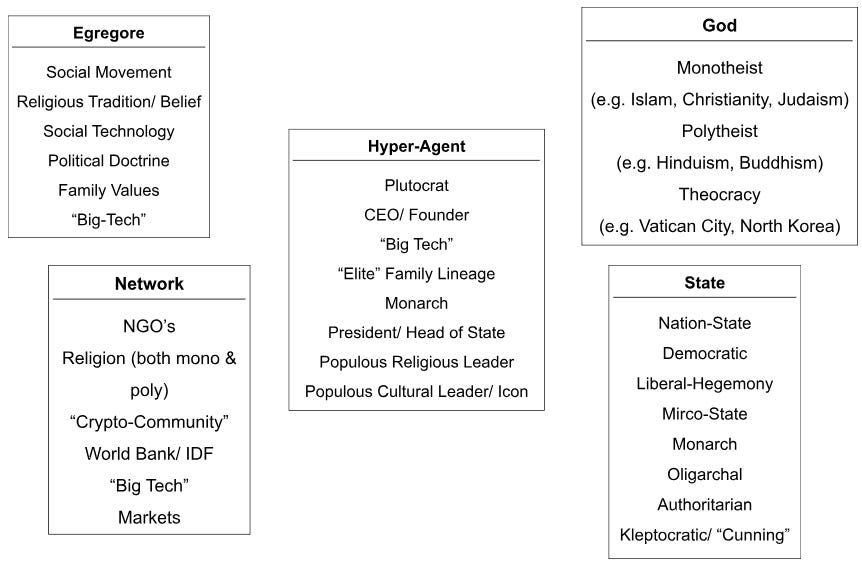
Not to say all egregores are completely homogenous, but they are unified enough to enable a shared perception and orientation towards the same action in some significant way. Maybe a useful but flawed analogy is a crowd; not everyone in a crowd, even one at a protest, shares exactly the same personal values but they are bound by the same shared values, and beliefs, the same thoughtform, to the point where they congregate en masse with other people who might not be of the same background, history, culture, but form a living mass with momentum, even a certain “charge”, and once that crowd gets moving, quite literally, it has a mind of its own.
See, for example: Vallée, 1975, The Invisible College: What a Group of Scientists Has Discovered About UFO Influences on the Human Race, Pp. 26-28, 34, 171, 199-200, 202; Vallée, 1979, Messengers of Deception: UFO Contacts and Cults, Pp. 7, 80, 112, 249., & Vallée, 1988, Dimensions: A Casebook of Alien Contact, Pp. 62, 90, 94-95, 142-143.
See also: Charles Fort, 1919, The Book of the Damned; John Keel, 1970, Operation Trojan Horse; Keel, 1975, The Mothman Prophecies & Jeffrey Kripal, 2010, Authors of the Impossible: The Paranormal and the Sacred.
That which is outside the bubble/umwelt is either not recognised—misrepresented by predictions from sensory data, or missed completely. Unknowns with “weight”, oftentimes what we might class as high-agency systems, can make the transition to known by breaking through the boundary of the umwelt (in essence bursting the bubble) and causes either an expansion (increased awareness) or contraction (if the intrusion is “heavy” enough, lasting trauma) in its place. Another way of thinking about this is by imagining a dark room. Peeking in, flashlight in hand, the beam of light represents how far your mind can “see” into reality. You know there is a room there, but you just can’t see most of it. Not just the “range” of how “far” but what you can see is also influenced by the conditions of the room and the flashlight. If the beam is too narrow you may miss something further back, in the shadowy corner. If the beam is too broad everything will be illuminated all at once and the details of the room will suddenly become impossible to distinguish. The beam is the extent to which our mind can recognise objects, systems and relations in reality. The shadows are the unknowns within it.
Meta-logical (“above” or “outside” regular logic and reason) harkens to concepts described in previous articles, like the biosemiotic uber-umwelt (that which is outside or regular sensory perceptions and regular day-to-day relevance sorting) to the more modern exobiological concept of the shadow biosphere (ecosystems and environmental niches that exist in such hard to imagine let alone access places that we miss entire forms of biology and evolutionary processes) in the sense that our logic—the thing that got us to the dance in the first place—is the very thing that means we miss or misconstrue these interactions.
Vallée, 1988, Dimensions: A Casebook of Alien Contact, P. 177.
Vallée, 1988, Dimensions: A Casebook of Alien Contact, P. 62.
How does a living body (e.g. bird) turn planetary-scale fields into meaningful direction? In fact, what really are the origins of life? Hang on, why does the subjective experience exist? That is a hard problem. And what’s up with dark matter and energy?
What are, for all intents and purposes, reflective objects that appear at an altitude consistent with geostationary orbit, found in a digitisation effort of archival photographic plates from the First Palomar Observatory Sky Survey, taken between 1949-1957. The last plates examined were from April 1957, several months before Sputnik launched in October 1957. None of these transients can be human satellites because there were none orbiting Earth at the time.
True, together both Vallée and Jackson’s interpretations on the context ominously suggest that Earth’s biosphere is a closed, highly managed ecosystem, physically and metaphysically overseen by abstract, absurd, possibly ancient forms of intelligence. But that is beside the point. Or maybe it is the point.
Diana Pasulka, Professor of Religious Studies at University of North Carolina Wilmington is particularly at the forefront of this research.
As I have stated previously: UFO burnout is real. Do not underestimate its effects.
For example, most of indigenous people can learn about extinction events from great flooding through their foundation myth, but they have not personally experienced it, and neither has any of their living ancestors, and thus this information has arrived from “outside” of what they could know through their own senses alone.
Specifically linking origins to the Pharaoh Thutmose III (c. 1500 BCE) as the founder of the first esoteric initiatory group.
Perhaps as a protestant response to the Jesuits.
Early members included Albertus Magnus, Roger Bacon, Paracelsus, Cagliostro, Nicholas Flamel, and Robert Fludd.
Describing how the ideals of Rosicrucianism were rediscovered after 120 years of being locked away and stored in a vault following Rosenkreuz’s proposed death in 1484.
The scale of influence could be measured through Metcalfe’s Law where the nodes being valued are agents in which the thoughtform is inhabiting and belong to the egregore network, the shared core values orienting goals that become enacted with literal consequence in the local and global environment.
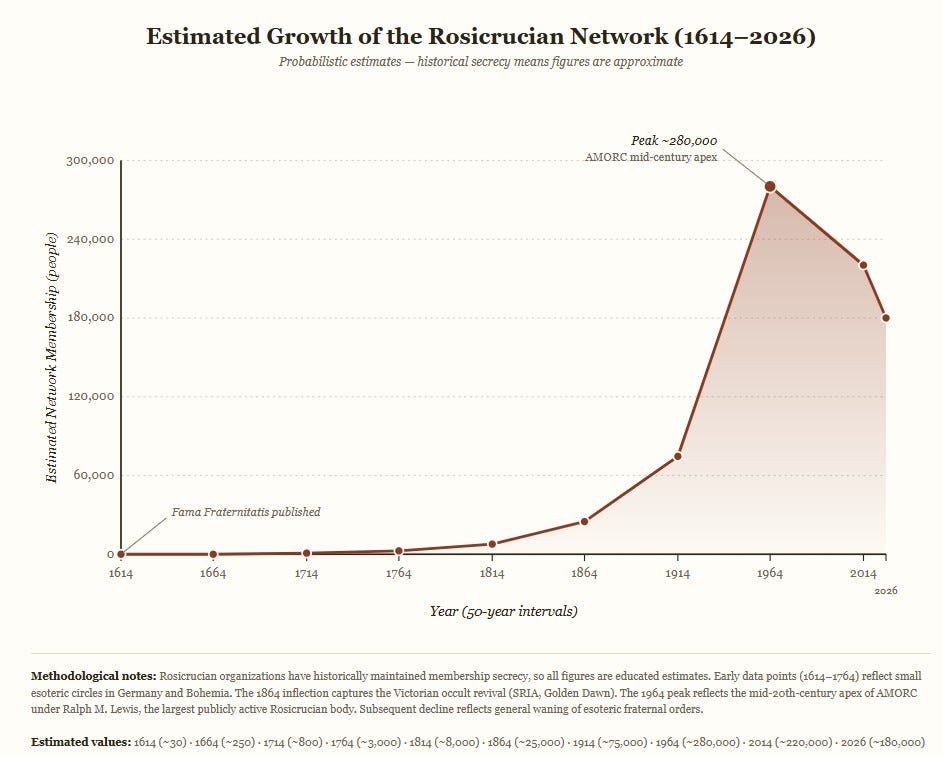
Heindel, 1909, The Rosicrucian Cosmo-Conception, P. 21.
Ibid, Pp. 23-24.
Philippe Dalleur, 2009, Finalism in “Interdisciplinary Encyclopedia of Religion and Science.”
In the sense of John Vervaeke extension of Mihaly Csikszentmihalyi’s seminal 1990 work on flow (quite literally “Flow”), and Pierre Hadot’s framing of ancient philosophy as askesis (contemplative practice rather than academic discipline), ideas foundational to both Vervaeke and Arthur Versluis when they discuss flow-states as continuous with the theoria of the Platonic tradition rather than reduced versions of it.
Interestingly, this article discusses the use of Facebook, Youtube, Zoom and other social platforms by Roscicrucian sects to communicate and spread their values, beliefs, and ultimately undertake passive recruitment or attraction to their egregore through these platforms. When viewed in the lens discussed in this article series this should come as no surprise: Rosicrucianism is an egregore and an egregore has to feature some form of network structure. For networks to expand, or simply remain in a healthy, stable condition they often connect to other network structures to gain (oftentimes mutual) benefit from bridging into these other networks and the services and advantages they provide. Indeed, as the article states, “Facebook has given us a way to connect with seekers who we would not have been able to before.”
True, that the argument could be made that the demographic of Roscicrucianism writ large (especially pre-twenty-first century) is fairly homogenous to European cultures as it was founded by Christian-elites were part of the initial founding and hence only a few cultures brought-in to The Order, but then again AMORC claim they hail from ancient Egypt, and as per the chart below (which is based off incomplete data so take with a pinch of salt), while numbers may have declined, diversity certainly rose.
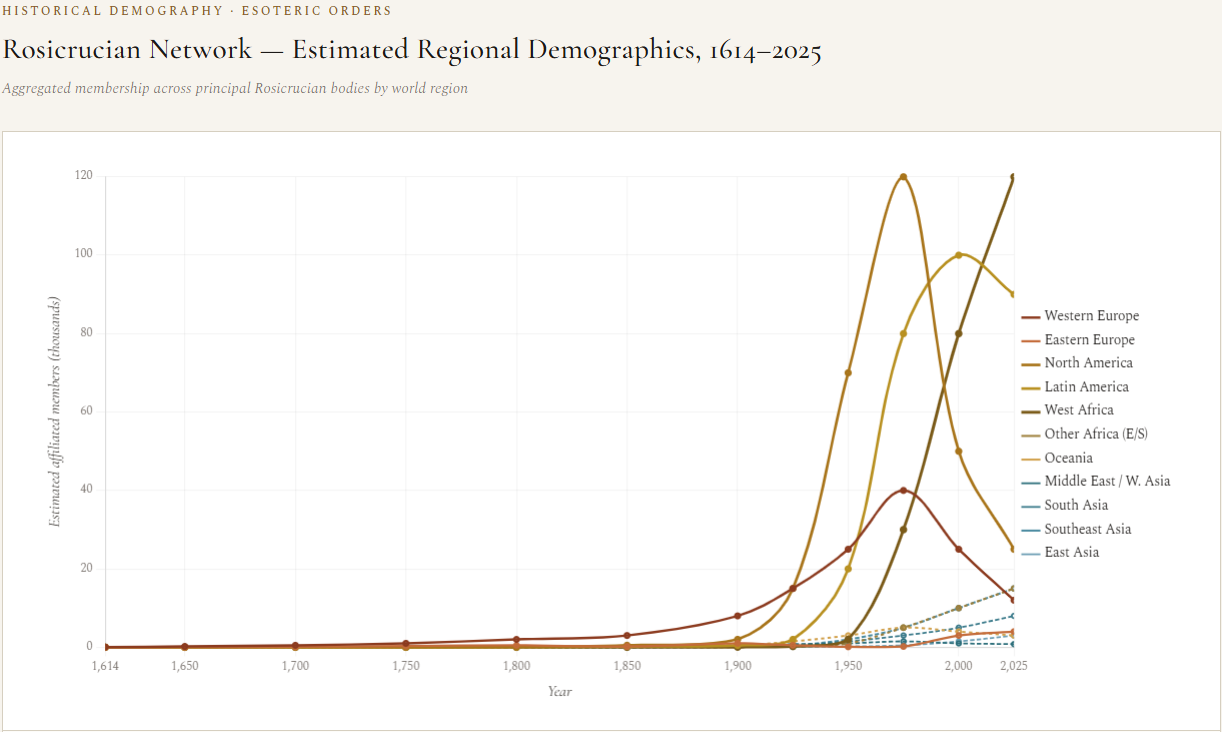
1614–1850: Western Europe and a faint Eastern European presence (Bohemia, Russia under Novikov) sustain the network at low levels, whereas early Anglo-Saxon America emerges via Kelpius’ Pennsylvania community.
1850–1970: Victorian occult revival, then AMORC's founding in 1915 in California, drives explosive growth in North America. By mid-century AMORC had Grand Lodges across Latin America and francophone Africa.
1970–present: Western membership ages and declines while West Africa (Cameroon, Côte d'Ivoire, Togo, Nigeria) and Brazil become the network's demographic centres.
Y-axis: estimated affiliated members (in thousands). X-axis: year. Linear scale shows the shift from near-zero baseline.
Heindel, 1909, The Rosicrucian Cosmo-Conception, P. 39.
Names like Johannes Kepler and Sir Francis Bacon, Georg Joachim Rheticus, John Dee, Tycho Brahe, and the Royal Society writ large were all associated with The Order in some capacity.
See: Sheldrake & Fox, 1996, The Physics of Angels for modern discourse, and look to sources like the Enuma Elish (c.1200 BCE) which explains the Babylonian cosmological architecture through the gods divided into two primary assemblies: first the Igigi, gods of the upper world and heavens who represent the celestial aspect of the divine order, then the Anunnaki, gods of the lower world (or Earth). Furthermore, the Egyptian Pyramid Texts (c.2500 BCE) relate to cosmogonies (multiple universal creation myths) through the competing myths of Heliopolis, Hermopolis, and Memphis, which, despite differences, all articulate in their own way a ranked emanation from a singular source into differentiated orders of being. In reading Daniel Mcbride’s The Egyptian Foundations of Gnostic Thought it is noted that “While the physical body belongs to sensible creation, the spiritual elements originate from on high, from the intelligible sphere of cosmic intelligence” (P. 31) and the agential aspect of these intelligences even back in Egyptian cosmogenies is made clear with mention of how “Seth is a self-directed agent who revolts against established order, even before birth in breaking through Nut’s side” (P. 222). With “angel” being synonymous with “agency” in regard to their proposed effect, it stands to reason that whilst ancient Egyptian and Mesopotamian myth did not use the angelic label, they certainly were echoing the scaled intelligence and causal influence implied throughout other mystery traditions.
And (not to get stuck on Father Christmas) but what is the myth of Santa if not a narrative of relationships. “Be good to those around you and you will be rewarded”; Santa knows exactly who has been naughty or nice. The mytheme of Santa is driven by relations between people.
And yes, I do consider the “UFO of God” case to be mythic too, even though (as author Josh Cutchin’s might say) its fabula is technically still unfolding, namely because it is still perpetuating the three levels required to consider a “narrative” or “set of experiences” a “myth”: i) it contains both rich superficial and deeper narrative structures, with all the key ingredients of an engaging story from hard lessons to equal parts misery and joy, from intrigue and mystery to defeat and rising once more, whilst also ii) covering some fundamental observations and experiences of reality passed on by word-and-mouth, through text wrapped in well-placed analogy, metaphor, and discrete symbolism, remembered through archetypal themes such as the Hero’s Journey, the Divine Feminine, the Trickster, the Sage Teacher, and then, iii) at its core, the myth seeds within it some fundamental truth about not just the “UAP question” or “basal spirituality” (even though it contains fruitful elements of both to pick at) but even more than that, the myth itself encodes, at its most obscure level, some essence of bedrock ontological truth: our relation to another. So that is why I consider both the Our Lady of Fátima and the UFO of God events as mythic in nature.
Perhaps under what frontier synthetic biologist Michael Levin might call “TAME” framework or Technological Approach to Minds Everywhere, in which he states:
“TAME formalizes a non-binary (continuous), empirically-based approach to strongly embodied agency. TAME provides a natural way to think about animal sentience as an instance of collective intelligence of cell groups, arising from dynamics that manifest in similar ways in numerous other substrates. When applied to regenerating/developmental systems, TAME suggests a perspective on morphogenesis as an example of basal cognition. The deep symmetry between problem-solving in anatomical, physiological, transcriptional, and 3D (traditional behavioral) spaces drives specific hypotheses by which cognitive capacities can increase during evolution.”
A great example of this is Pierre Tielhard de Chardin and Vladimir Vernadsky’s conceptual planetary-scale system of the Noösphere (which I have previously written at some length about in the context of artificial spaces developing cognitive functions) what is essentially a “thinking substance” that envelopes the Earth as our human cognition expands, melds with other cognition through various substrates like technological communication systems, integration of machines and more intricate mechanisms into daily life, and the desire for consciousness to seek a deeper understanding of itself (being self-reflexive), its environment (being curious) and to imprint itself onto its surroundings (being autobiographical), as more cognitive power gets generated within the biosphere, by way of the technosphere, sociosphere, politicalsphere, then leaking out into the wider atmosphere, down into the geosphere and hydrosphere, cracking the cryosphere, even hitting out to the magnetosphere—this thinking substance was, in Chardin and Vernadsky’s minds, quite literally wrapping the Earth and the agencies within it in a substrate that promotes collective thinking, and reinforces itself through its own intelligent development (akin to what is now called in biology autopoiesis and allopoiesis). That is, if these systems are not hijacked by individual agencies with its own agenda and asymmetric causal influence. The link to thoughtforms is thus inferred.
I mean, alright, in the sense of tight-nit communities and wherever and whenever empathy, compassion and compersion are displayed en masse. That being said, whilst I never want to bring geopolitics into such an esteemed eschatological case like this, the historical context is “World War One” and thus I would be remiss if I did not mention the slight irony here when proposing how good us humans are at connecting our minds together, only to frame it in a historical contingency that is the exact antithesis: minds—human minds—competing in zero-sum multipolar traps and destroying each other on a grand, collective scale—quite obviously this is not the best example of how good those connections can be. But hopefully you can think of some positive examples if not from history from your everyday life where us humans can pull our minds together, connect, and overcome or be overjoyed, bound, cooperating, coordinating, cohesing in an overall net-positive way.
That space, the mundus imaginalis of fictional creation, ideation, mythology, and poetry, epics and metaphors, wisdom and narrative, that French philosopher Henry Corbin first described through his work Creative Imagination in the Sufism of Ibn ‘Arabi (originally published in French in 1958 as L’imagination créatrice dans le soufisme d’Ibn ‘Arabi).
For example,
the November 14, 2004, Tic Tac Encounter where Carrier Strike Group Eleven, including the nuclear-powered aircraft carrier the USS Nimitz and the USS Princeton missile cruiser, was conducting a training exercise some 100 miles off the coast of southern California when Commander David Fravor of the elite Black Aces squadron described encountering an object about 40 feet long, shaped like a Tic Tac, with no wings, no rotors, and no obvious means of propulsion. Lt. Cmdr. Alex Dietrich, Fravor’s wingwoman, described, “No predictable movement, no predictable trajectory.” Posing no obvious threat (other than its absurd appearance in a restricted military area of operations), when Fravor and Dietrich broke off their intercept attempt the UAP accelerated away, vanishing, only to reappear within a minute at the exact coordinates of the missions pre-briefed—classified—CAP point, the designated area where Strike Fighter Squadron 41 would rendezvous at the end of the mission. Understandably this left the fighter pilots feeling unnervingly vulnerable and more than a little “confused when it disappeared.” Of course, in part, this could be explained strategically: a technological tour de force, essentially: “Look, you can’t catch me, and now I am at your secret rendezvous point” which, according to Fravor’s conclusions that the technology was “far superior than anything that we had at the time”at the House Oversight Committee, it clearly had a similar effect. However, small details like the object ascending by mirroring Fravor’s descending “spiral” maneuver appears a response pattern that is neither offensive nor defensive in any classifiable sense, thus it is hard to assign a strategy or real motivation except an absurdly “playful”
tricksternature.the April 18, 1961, encounter of Joe Simonton, a 60-year-old chicken farmer in Eagle River, Wisconsin, who stepped outside his home to find a silver disc-shaped craft hovering near his yard. Three short, dark-complexioned humanoids in black uniforms were visible inside, then one gestured toward a jug, which Simonton interpreted as a request for water. He filled it, returned it, and was given four small, bland, perforated pancakes in exchange. The craft then silently accelerated away. The entire encounter lasted roughly five minutes. Simonton was sober, well-respected and practical. Not the hoaxing type. The USAF’s Project Blue Book classified the case as sincere but unexplained and subsequent lab analysis confirmed the pancakes contained entirely ordinary terrestrial ingredients. The absurdity is abundant: beings capable of apparent technological mastery were simply cooking, exchanged food through wordless gestures, and left no meaningful evidence. Vallée identified this as characteristic of a phenomenon that conditions rather than informs, that is by planting irreducible, symbolically loaded experiences that resist both literal and psychological dismissal but have no obvious strategy other than the self-imposed strangeness, operating with a (meta-)logic orthogonal to any framework human rationality has yet produced.
See also Patrick Jackson’s “sphere network” hypothesis for another case study emphasising the command and control aspect specifically “orbs” exhibit.
Sheldrake & Fox, 1996, The Physics of Angels: Exploring the Realm Where Science and Spirit Meet, P. 74.
Cognitive in the most basic sense of i) goal orientation and ii) independent action.
Again: this is not a comment on morality.
Mirrored in the Freemasonic ideal of “As above, so below”.
I continue to research this through another ongoing article series called The Expanse which explores the development of organisms, moreover “life” in general in what we would refer to as the technosphere, more specifically “artificial space” looking at contemporary technological substrates like blockchain, AI networks, and the blend between physical and digital infrastructure and substrates.
William F. Vallicella, 2002, A Paradigm Theory of Existence: Onto-Theology Vindicated, Pp. 255-256.
See: Rupert Sheldrake & Matthew Fox, 1996, The Physics of Angels: Exploring the Realm Where Science and Spirit Meet.
Although if you read the work of Professor of Religious Studies Diana Pasulka and learn of the lore surrounding people like “Timothy Taylor” who is an active NASA mission-controller, also owning multiple patents in fields of medical technology and says that he receives the information enabling his success via downloads from higher intelligences. Famously, in Pasulka’s American Cosmic, Taylor went through a conversion experience whilst visiting the Vatican archives, so it might be more accurate to say he believes this information arrives to him from angelic intelligences, much in-line with these early theologians, and the process by which mystery traditions like Rosicrucianism was founded upon.
Stavish, 2019, Egregores: The Occult Entities That Watch Over Human Destiny, P. 21.
Take it from me, save yourself the hassle.
In some ways it comes down to defining individual “Markhov blankets” to understand what cognition or individual self sits where in relation to others and the environment.
Especially given the amount of people who actually go missing with regard to tip-of-the-spear scientific and engineering projects for states around the world.
Some good places to start are “UFOs and Nukes” by Robert Hastings, the two-part “UFOs and the National Security State” by Richard Dolan, and “In Plain Sight” by Ross Coulthart.
Thanks Joshua Cutchin for bringing my attention to this tip in his wonderful book “Fourth Wall Phantoms” (2025).
DARPA being the Defence Advanced Research Project Agency—the people who invent new military—intelligence tech.
Wherein the people privy to information outside of normal public consumption (aka military—intelligence analysts and officials) allow classified information to be disclassified and shared. Ideally for good old fashioned transparency. Although, others are more suspicious of intent.
Brown also named a specific individual as the central coordinator of a network underpinning those who hold access to the most classified material and knowledge stored in military—intelligence circles. Something akin to being positioned as Deputy SAPCO (Special Access Program Coordinator) for DARPA at Northrop Grumman, which Knapp reportedly verified through separate sources.
System names including SILVIA, SAdie, Ocarina (tied to Cognitive Code) are linked by Andreasen to the quasi-mythical “Project Looking Glass”.
The implication being that, just as Prometheus went against the collective will of the other Gods and gave the gift of “fire” to humans, for quite some time we have been gifted certain ideas, technologies, perhaps even philosophies by non-human, UAP-related agencies. I warned you—you will need some strong priors for this one.
Literally, take the classic Central Intelligence Agency, or the not-so-classic National Geospatial-Intelligence Agency, National Reconnaissance Office, or the Office of the Director of National Intelligence.
Who has since helped to found “Sky Watcher”, a company with the ambitious aim of “redefining how we observe, analyze, and understand aerial activity” by taking “a disciplined, data-driven approach—integrating multi-domain sensing, cutting-edge aerospace research, and real-world operational experience” and turning “highly anomalous observations into scientifically grounded intelligence—expanding our technical understanding of aerial activity”. (From the Skywatcher website.)
Most famously, the “5 Observables” framework was developed by Luis Elizondo and his team at the Pentagon’s Advanced Aerospace Threat Identification Program (AATIP) as a filter for distinguishing genuinely anomalous craft from conventional ones:
Anti-gravity lift (positive lift): staying aloft and overcoming gravity with no visible means of propulsion: no wings, rotors, exhaust, or control surfaces.
Instantaneous acceleration: abrupt changes in speed and direction at G-forces that would destroy a known airframe and kill a human pilot.
Hypersonic velocity without signatures: travelling well above Mach 5 with no sonic boom, no heat plume, and no visible disturbance of the surrounding air.
Low observability (otherwise known as cloaking): appearing intermittently or not at all on radar, infrared, and visual sensors, sometimes seeming to actively evade tracking.
Trans-medium travel: moving seamlessly between air, space, and water without slowing, breaking up, or losing performance at the boundaries.
At least, assuming we have persuaded it and not the inverse is true instead.
If we look at our solar system as a hyper-agential system (maintaining the ability to, without much warning, completely stop all other agency on Earth), then we understand why it is important to understand and analyse our agential position in relation to a larger hyper-agential system, one that we are possibly embedded within. Not to sound dramatic but it is a matter of life or death. Hyper-agency exists in our universe. Our universe could well be hyper-agential itself. It seems hyper-agency also exists at a microscopic scale, just like the splitting apart of an atomic nucleus generates extreme energy, or just like cell networks can stop working with the animated body and completely shut it down, just like mycelial networks whose fungi infect host insects, controlling their movement and eventually using them to propagate their diaspores. Outside classical biology in more imaginal spiritual traditions, what are guardian angels? Daemons? Devas? Hyper-agencies asymmetrically influencing the direction of the other agency in question.
According to “There were continuous ‘presences’ in Peirce’s home in Milford, Pennsylvania, and strange lights in his bedroom. His father was a math professor at Harvard, his brother was Secretary of State. His paramour, Julia, was a Gypsy priestess.” (Vallee, Forbidden Castles, 2025, P.375-376 Kindle ed.)
In other words, one of the founders of biosemiotics—an active method of engaging biological systems, in other words: life, using sign systems as a means to create feedback loops between the interpreter/observer—environment/context/umwelt relationship, and the object/system/mind, and the sign/symbol, making the tetradic system sign-making. And Peirce was frequently experiencing, according to this account, anomalous encounters with unexplainable lights and “presences” in his home.